
POLICE are warning motorists who drive under the influence of alcohol and drugs that they will be caught and face serious consequences.
Officers and staff from the joint roads policing unit of Hampshire Constabulary and Thames Valley Police have arrested 102 people in the region during the first 15 days of a dedicated operation to deter and detect drink and drug-driving.
Additional roads policing patrols are being conducted throughout December with every driver involved in a collision being breathalysed by police. Regular roadside drug tests are being carried out when there is reasonable grounds to suspect a motorist may have a trace amount of an illegal drug in their body.
Figures for the whole of Hampshire Constabulary between December 1 and December 15 include 85 arrests for drink offences, 14 arrests for drugs offences, and seven arrests for failing to provide a specimen.


Arrests so far have led to 74 charges, 19 decisions to bail after arrest, and 12 decisions to release with no further action.
Superintendent Simon Dodds, head of the joint roads policing unit, said: “Driving under the influence is a deliberate act. If you are going out and plan to be having a drink, remove the temptation; leave your keys at home and arrange a lift.
“If you know somebody is driving under the influence – it could even be your friends or family – tell us so we can put a stop to it before it is too late.”
If anyone suspects someone is driving while impaired by drink or drugs, please take action to report details to police. Call Hampshire Constabulary on 101 or text 80999 with all the details of the vehicle, driver, location and times. In a life-threatening emergency, always dial 999. If you wish to remain anonymous, phone the independent Crimestoppers charity on 0800 555 111.
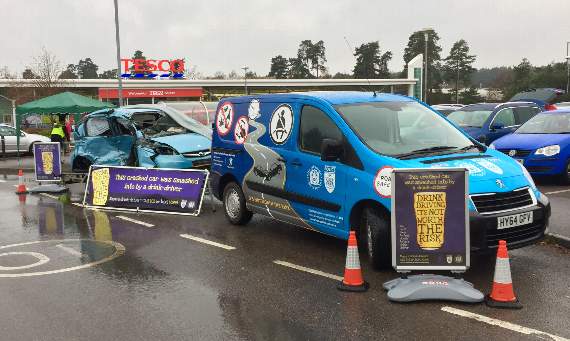
Hampshire Constabulary has been taking a crashed car display to public places throughout December, including Bordon and Whitehill. The exhibition highlighted the force’s commitment to Project Pictogram, an initiative where a series of circular white symbols with red outlines are displayed on vehicles to a ‘nudge theory’ approach. This concept is designed to influence motorists toward safer behaviour including the avoidance of driving while impaired by alcohol or drugs.
The car in the display was involved in a fatal road crash on the Isle of Wight in 2012.
Sergeant Rob Heard, Hampshire Constabulary’s road safety lead, said: “Motorists who take to the road after drinking alcohol or taking drugs should be under no illusions about what they can suffer. Lives are ended or ruined with lasting emotional trauma for the families of all involved. Breaking the law carries the risk of a criminal conviction, time in prison, a ban from driving, and the loss of your job.
“Roads policing officers are committed to doing all we can to make our roads safer through education and enforcement. Our extra patrols this December will continue with specific attention focused on intelligence received about suspected offenders.”
He added: “I’d like to take this opportunity to thank members of the public who’ve been helping to spread our advice and warnings so far, particularly all those who’ve attended our local road safety events and contacted the police with any concerns about a drink or drug driver. Your information and support is always important to ensure more people understand and remember why it’s not worth the risk.”
Particular concerns have been raised about motorists being found to be over the limit the morning after drinking. Police are working with partner agencies to promote the ‘Morning after Calculator’, which is a free app to download. It’s also available free online at morning-after.org.uk.
Further advice:
* It is not possible specifically to say how much alcohol you can drink and stay below the limit;
* The way alcohol affects you varies depending on your personal characteristics. These factors include weight, age, sex and metabolism (the rate your body uses energy), the type and amount of alcohol you’re drinking, what you’ve eaten recently, and your stress levels at the time.
Further consequences:
A drink driving conviction is a criminal conviction. Here are some of the consequences of receiving a criminal conviction:
* Your car insurance could go up. Having a criminal record will make it extremely difficult to get any other kind of insurance;
* To buy a mortgage you have to disclose any unspent conviction;
* You may not be able to travel to America if you have a criminal conviction. Travelling to a country where you need a visa or a working permit can be very difficult with a criminal record;
* Colleges and universities will have their own policies about misconduct and getting in trouble with the police could have a knock on effect with your education;
* Lying to your employer on any kind of application which asks you to disclose any criminal convictions could be seen as fraud and lead to a further conviction;
* Getting into trouble with the law could be seen as gross misconduct by your employer and you could lose your job;
* Having a criminal record could make it very difficult for you to get another job.
Comments
This article has no comments yet. Be the first to leave a comment.