
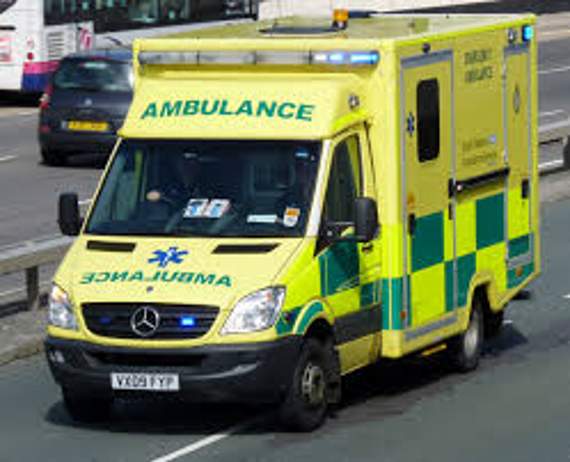
SOUTH East Coast Ambulance Service (SECAmb) is still consistently failing to achieve vital targets set for ambulance response times, new figures have revealed.
For the year to August 2016, the most serious Red 1 emergency calls involving life-threatening respiratory or heart issues in the South East Coast area were responded to within the targeted eight minutes only 67.8 per cent of the time.
And for Red 2 calls, comprising all other life-threatening emergencies, SECAmb responded to only 59.9 per cent of calls within the vital eight minute window.
The target for Red 1 and Red 2 calls is to reach patients within eight minutes at least 75 per cent of the time.



The new figures were released this week by GMB Southern, the union for ambulance staff, which has called for “proper investment and full recognition of skills” by the Government to solve the problems around the recruitment and retention of ambulance staff in the South East.
Paul Maloney, GMB Southern regional secretary, said: “The situation is at a critical level when less than 72 per cent of life or death emergency calls [across the South East region] are responded to within eight minutes.
“The government has created conditions which mean the public now have to wait longer for the ambulance service to respond.
“High vacancy rates and staff shortages mean existing staff have to shoulder more responsibility and crews responding to 999 calls are not adequately staffed.
“The current leaving rate in England of 6.1 per cent for qualified ambulance staff is outstripping the joining rate of 4.3 per cent with the situation getting worse.
“With vacancy levels at over 1,000 in the ambulance service, the Government must act fast if they want to seriously try and hit the response time targets.”
A SECAmb spokesman said: “We are committed to improving our current response time performance. Year-on-year increases in demand mean we are handling more 999 calls than ever before.
“We are working hard to recruit additional staff to tackle a national shortage of paramedics and to increase the number of staff working in our control rooms.
“We are very proud of the efforts of all our staff in responding to this increase in demand. We will continue to prioritise responding to our most seriously ill and injured patients and would like to remind the public that they should only dial 999 in the event of a serious emergency.”
• It comes after an independent review commissioned by SECAmb found “no harm” was caused to patients by a controversial pilot scheme that delayed emergency response times.
SECAmb has come under intense scrutiny after it was revealed that the trust ran the Red 3 pilot at the end of 2014, which altered how the service dealt with less serious NHS 111 calls and resulted in up to 20,000 people having their ambulances delayed.
The scheme was criticised by NHS England for “putting the public at risk” and SECAmb chief executive Paul Sutton, who instituted the pilot, stepped down from his post in March.
However, a patient impact review into the scheme published at the end of October found no evidence that any patients died or were even harmed as a result of the pilot.
The review was required as part of the formal undertakings SECAmb was asked to complete by NHS Improvement in addition to the forensic review into the Red 3 pilot undertaken by Deloitte and already published, and an external governance review to be undertaken next year.
SECAmb acting chief executive Geraint Davies said: “We are satisfied that this report, which was led by an independent and external clinician and which looked at 185,000 calls, has identified no evidence of patient harm attributable to the pilot.
“We do however recognise that there were significant governance and other failings around the pilot.
“I am keen to ensure that the trust now moves forward. SECAmb is going through an extremely challenging time but I am, with my senior team, committed to making the changes required to improve our service.”
Comments
This article has no comments yet. Be the first to leave a comment.