
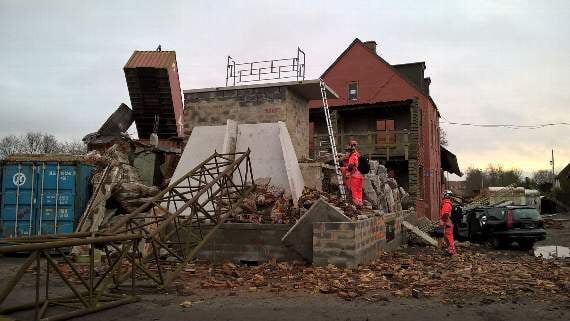
An elite team of Hampshire firefighters has been undergoing extreme weather training in Denmark where temperatures can drop as low as minus 16C.
The nine-man group camped out in the unforgiving conditions and tackled disaster simulations involving earthquakes and tsunamis to test the skills of the UK’s International Search and Rescue team (UKISAR).
The contingent from Hampshire Fire and Rescue Service worked with firefighters from elsewhere in the country as well as fellow experts from France, Russia and Denmark.
The team had to deal with four earthquake scenarios which featured piles of rubble and debris and collapsed buildings, including a school and hospital, as well as overturned cars and the shell of a plane.
-Cllr-Lulu-Bowerman-Tim-Lawton--Image-LDRs.jpeg?width=209&height=140&crop=209:145,smart&quality=75)

The immersive exercise included a pregnant woman made homeless by the disaster and a casualty who refused to be rescued by a man on religious and cultural grounds.
Other actors were tasked with physically obstructing the crews or playing casualties who had lost limbs or suffered other serious injuries.
The fictitious community also had no power or water.
Base of operations manager Robin Bates, of Hampshire’s Urban Search and Rescue team and UKISAR, said: “Training exercises like this save lives, there is no doubt of that. These scenarios give you the chance to practice your skills in a way that is as close to a real event as possible.
“You also get the chance to co-operate with other teams and see how this would work in a real disaster situation.”
In addition to cold weather, the firefighters were whipped by fierce winds and torrential rain as they toiled in swampy conditions.
More than 160 people were involved in the exercise in Randers in Denmark that lasted eight days.
Crew manager Bates has been with the USAR and UKISAR teams for 15 years and been deployed to the earthquake in New Zealand and severe flooding in Bosnia, plus training exercises in Germany and Italy as well as several locations across the UK.
He told the Herald this month: “We are often sent out to help in countries which have nothing at all.”
This exercise was funded and co-ordinated by Danish rescue organisation Falck.
The Hampshire team members working with crew manager Bates were Adrian Johnson, Barry Atkins, Neil Brice, Jason Avery, Phil Crook, Marcus Hill, Kevin Fyfe and Simon Forster.
Back on home territory, crew manager Bates has been speaking about the UK’s first mobile field hospital for disaster zones, which Hampshire Fire & Rescue Service has been able to demonstrate in a 3D virtual tour.
According to Mr Bates, the facility, set up by UK Fire Services, can be transformed into a medical centre in two days and a 40-bed field hospital in as little as four days.
Once erected, it is the size of four football pitches and equipped to carry out up to 20 operations a day with the capacity to airlift casualties.
It would be a fully operational field hospital with departments for surgery, A&E and maternity. It also has a morgue.
The kit that makes up this hospital, which is designed to be used for up to 90 days at a time, is currently being stored in a warehouse by the Department of International Development ready to be deployed at a moment’s notice.
As project section leader in charge of accommodation and logistics, Mr Bates said: “The work that has gone into this is incredible. To be able to go to a disaster zone and immediately put up such a vital lifeline will make a huge difference to those in need.
“As well as treating the injured, this hospital will be able to help prevent minor injuries becoming major with a team of highly-trained trauma doctors and nurses.
“This facility will save lives without a doubt and improve life for people who have lost everything in countries where the infrastructure has been completely wiped out.”
He added that the hospital had been certified by the World Health Organisation.
The UK has become the sixth country to have such a facility, alongside Russia, China, Japan, Australia and Israel.
In addition to setting up the hospital, firefighters will have other duties such as assisting with triage and treating patients as they are being transported to the hospital, with their immediate emergency care training.
The firefighters involved have had to develop their skills in areas such as sanitation, utilities, waste management and food hygiene in order to support the facilities of the hospital.
While the hospital is most likely to be used in disaster zones to support the work of the UK International Search and Rescue firefighters, it could also be used in Britain should severe flooding or an epidemic close major hospitals.
Comments
This article has no comments yet. Be the first to leave a comment.