
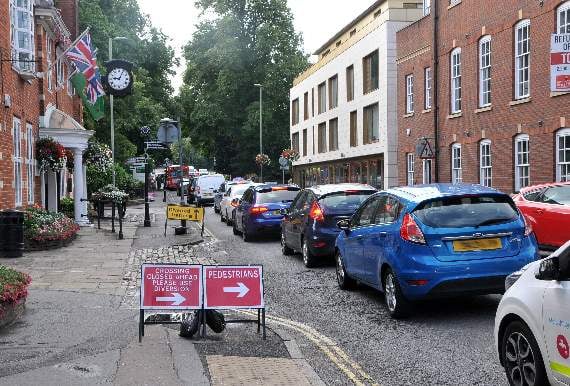
THE LATEST air quality data shows an “alarming rise” in levels of nitrogen dioxide (NO2) in Farnham town centre, potentially placing the town in the worst two per cent of areas in the UK for air pollution, says Farnham-based air quality consultant David Harvey.
Addressing attendees at the Farnham Pollution Summit, co-hosted by South West Surrey MP Jeremy Hunt and the Herald last Friday, Mr Harvey said the latest data indicates the annual mean concentration of NO2 in The Borough is on track to reach around 50 microgrammes per cubic metre (µg/m3) this year.
This is significantly above the EU and UK legal limit of 40 µg/m3 – and a jump of around 10 µg/m3 from the levels recorded in The Borough in 2018.
Speaking at the summit, Mr Harvey, who has given evidence at numerous public enquiries and at House of Commons select committees, advocated reducing The Borough down to one lane of traffic, widening the pavements and installing a new cycle lane, as well as a “widespread pedestrianisation scheme” in the town centre.

_-004.jpeg?width=209&height=140&crop=209:145,smart&quality=75)

He said: “I came here today on my bicycle via the notorious Farnham one-way system which took me through The Borough. It’s a hazard to cyclists, a hazard to pedestrians and, because of pollution, a hazard to health.”
Mr Harvey praised Waverley Borough Council, and specifically its head of environmental services Richard Homewood, for “sorting out” the problems with the air quality monitoring in Waverley that saw the council withdraw its 2016 air quality status report.
“Waverley’s monitoring protocol now is as good as I’ve seen in any local authority in the country, and I’ve got every confidence that data is reliable,” he said.
However, focusing deliberately on the data from two air quality monitoring stations in The Borough, which both came in just below the legal limit last year, Mr Harvey highlighted “some quite high” average monthly concentrations this year, ranging from 40.7 to 73.6 µg/m3.
Mr Harvey explained that across the year, this averages out at 60.3 µg/m3. And when adjusted for ‘local bias’, allowing for discrepancies between monitoring equipment, leaves an average NO2 concentration of 49.1 µg/m3 so far in 2019.
“I suspect that’s going to be representative of the concentration in The Borough for the year,” the expert continued, “partly because the pollution levels are usually higher in November and December.”
He added: “There’s been quite an alarming rise in the 2019 data, and once these figures are verified and released to the public, I think people will be quite justifiably concerned.”
Pointing to data for The Borough spanning the past decade, Mr Harvey said NO2 has on average exceeded the legal limit in seven of the eight years in which data is available.
“Almost every year, the data from The Borough has exceeded the top band of the national measurement, the highest 2.5 per cent in the country.
“And this is even more relevant now than it used to be, because there are now residential properties in The Borough, where there didn’t used to be.
“The EU legal limits are consistently exceeded in Farnham, and poor air quality will be affecting people’s health.”
And on possible solutions, Mr Harvey added: “It’s very clear the pollution is caused by traffic, and the most effective way of dealing with poor air quality is to reduce the traffic.”
Comments
This article has no comments yet. Be the first to leave a comment.