
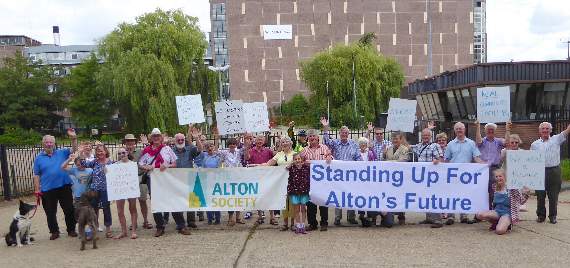
“ALTON deserves better” is the resounding message from the Alton Society as it seeks to make an 11th-hour challenge to the recently approved development brief for the Molson Coors brewery site.
So dissatisfied are members with the “unimaginative town centre housing estate” proposed in the brief that they have launched a residents’ survey to gauge public opinion on what they believe to be “serious flaws” that should be subject to “challenge and improvement”.
If supported by the public, in a bold move the Society will be asking the project board which produced the brief (representatives of East Hampshire District Council, Alton Town Council and Molson Coors) to “think again”.
While Molson Coors is on record as saying it wants to leave a legacy of which it and the town can be proud, the Alton Society is adamant: “This is definitely not it.”




In seeking a “Rolls Royce solution rather than a mediocre one”, the Society is urging residents to express their views to see if the feeling is more widely held.
“East Hampshire District Council has said it is not too late to do this,” according to Alton Society chairman Bob Booker, who added: “Along with others, we have pushed for a vision for this site which is innovative and creative but have ended up with more or less what the project board originally proposed: a housing estate in the middle of the town with minimal benefit to the other residents of Alton. The site should have a mix of civic functions as well as homes.”
While the Society accepts that the development has to be commercially viable, its criticism is clear: “Despite the engagement of the public in the preparation of the project brief, it always seemed weighted toward getting the result Molson Coors desired.”
The Society believes there is room for more flexibility in order to achieve what Alton needs, and that its counter proposal would be more attractive and command higher valuations.
In a bid to highlight where it believes improvements can be made, Alton Society has closely dissected the development brief, pointing out that while space is provided for a community facility “it is in the wrong place and is too small”.
The Society believes it should be a multi-purpose performance hub to encourage the arts in the town and cater for the expanding population, located on a larger, more accessible site on level land to the south of the river, not on the northern slope as proposed.
Likewise the proposed hotel which, it is felt, should be located on the corner adjacent to the roundabout joining Drayman’s Way and Turk Street, not in an area dedicated to business units.
In the Society’s view, the business units should be located along the boundary of Turk Street with access to the units, the hotel and the community facility via the current entrance. This would facilitate undercroft parking, with a pedestrian area above which could be used for staging outdoor events.
While a parking survey of East Hampshire District Council town centre car parks suggests there is spare capacity, negating the need for decent on-site parking, the Society argues that no consideration was given to the town’s on-street parking problem, nor to future population growth.
Mr Booker said: “In the Society’s view this is a flawed piece of evidence and does not stand up to scrutiny. Currently, public car parks have charges. Car owners use residential streets as parking is free. Unless East Hampshire District Council intends to change its charging policy this will continue and only get worse when the extra housing planned for the town is built.
“Our population is set to rise over the next 12 years from 18,000 to 25,000. Where is the forward planning? All these people will have access to cars and will use them.”
A major feature of the site is the planned ‘green area’ along the River Wey,
which the Society believes should be further enhanced and expanded to create an attractive recreational parkland setting for residential, community and business units.
The Society has laid great emphasis on tackling the chronic shortage of apartments in the town, particularly ‘starter flats’ for singles and couples. Alton’s neighbourhood plan identifies sufficient housing allocations for other types of dwellings so the Society believes “we should be bold in our vision for this site”.
And it advocates the running of a competition among architects to attract “the very best designs for the site, to fulfil the vision and aspirations we know are possible”.
It advocates the building of apartments north of the river (along the lines of Waterside Court, adjacent to Kings Pond) which can be accessed from Drayman’s Way. This would negate the need for the project brief’s second entrance at Turk Street and for the associated road bridge over the River Wey.
Mr Booker added: “We have been advised we have to be prepared to compromise. We have a responsibility to Altonians to ask, why? This is a unique, once-in-a-lifetime opportunity and by adopting the Society’s proposals the developer will still make its profit and the town gets the apartments and flats it needs, plus decent employment opportunities. Link this with a hotel and a state-of-the-art community facility, plus an excellent green space, you then have a real legacy.”
Comments
This article has no comments yet. Be the first to leave a comment.