
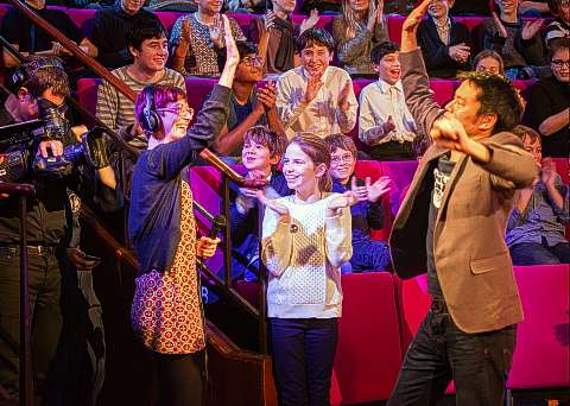
A TEENAGER from Alton has starred in the annual Christmas Lectures presented by the Royal Institution and televised as part of the BBC’s Christmas content.
Aoife Reid, 13, who attends Cheam School, supported Christmas lecturer Kevin Fong with an exciting demonstration for the show.
In honour of Tim Peake becoming the first British member of the European Astronaut Corps and the first Briton in space for more than 20 years, human survival in space was the focus of this year’s Christmas Lectures, the Royal Institution’s much-loved annual science programme for young people.
As Tim adjusts to life on board the International Space Station, Mr Fong was planning to take his young audience on a journey from planet Earth into low Earth orbit and beyond. This was to be the story of human survival against all the odds; the story of how science, medicine and engineering come together to help answer our biggest questions about life, the Earth, the universe, and our place in it.
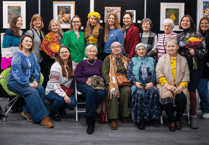
Aoife volunteered to help show how dangerous acoustic vibrations can be during a rocket launch. Her singing was played through a speaker below a wine glass, which shattered when the right frequency was hit. The sheer power of the rocket can cause all sorts of acoustic stresses during launch, so engineers have to do thousands of hours of testing to make sure their spacecraft won’t become damaged.
Aoife’s demo featured during the first programme called Lift Off!
“The Christmas Lecture was amazing,” said Aoife. “I love singing which is why I volunteered to be part of the demonstration. I’m really glad I was picked. I enjoyed it but it was hard to make sure I had enough breath to keep the note going long enough to break the glass.
“I definitely want to be a scientist when I’m older, maybe a biochemist. And I’m looking forward to watching the lecture again on TV at home.”
Mr Fong said: “Today’s generation of young people are our future scientists, engineers and space explorers, and they are in a truly unique position. We are at a really exciting point in space exploration. It’s incredible to think there have been people up in the International Space Station orbiting Earth since 2000.”
He continued: “I wanted to get people attending and watching this year’s lectures thinking about all the amazing things that we, as a species, are capable of doing, and to communicate the excitement I have always felt about the adventure of human space exploration. To send a human into space requires the combined imagination and creativity of thousands upon thousands of people, from a huge range of scientific and engineering disciplines, all working together. No one person can ever see all the moving parts, but every person is vital in the process.
“I hope that these lectures have demonstrated that the international currency of science is ideas and taking part in the journey of exploration is an incredible experience that is open to everyone. Within the limits of human imagination anything is possible.”
Filmed in front of a live audience in the iconic theatre at the Royal Institution of Great Britain, the original science and engineering events for children were pioneered by Michael Faraday in 1825 and have long been seen as a favourite British Christmas tradition.
The 2015 Christmas Lectures are still available on BBC?iPlayer.
Comments
This article has no comments yet. Be the first to leave a comment.