
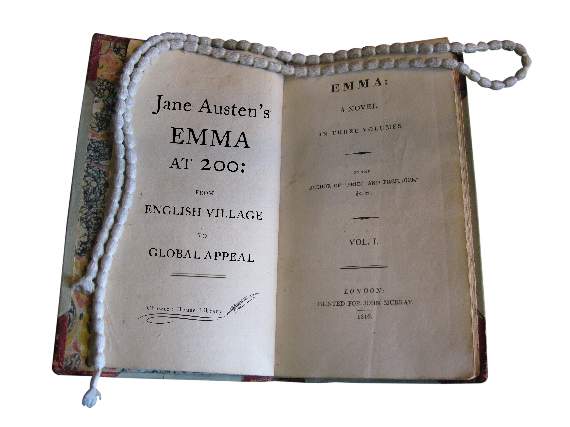
THE 200th anniversary of Emma, one of Jane Austen’s most popular novels, is being marked with a special ‘Emma at 200’ exhibition at Chawton House Library, supported by the University of Southampton.
It is also being celebrated at Jane Austen’s House Museum with a new exhibition ‘Emma in Print’, which explores the stories behind the publication of the novel.
Emma at 200: from English Village to Global Appeal opened at Chawton House Library in March to celebrate the global nature of the novel, its reception through the centuries, and its enduring popularity.
Jane Austen wrote and revised some of her most famous works, including Emma, while living in a cottage in the village (now Jane Austen’s House Museum), making frequent visits to neighbouring Chawton House, owned by her brother Edward Knight.




Dr Gillian Dow, executive director of Chawton House Library and University of Southampton Associate Professor in English, is curator of the exhibition.
She said: “Jane Austen’s ‘Emma’ is often considered to be the most accomplished of her novels, and it’s the one that is truly inspired by her setting of three or four families in a country village.”
It has been suggested that Donwell Abbey in Emma was modelled on Chawton House and that the book’s fictional village of Highbury was based in part on nearby Alton.
Among the many items on display in the exhibition is an English first edition of the novel, alongside a first edition from the United States and a first French translation – both published in 1816. The book has since been translated into numerous languages worldwide.
Dr Dow said: “Many people are surprised that Jane Austen was published in countries beyond England in her own lifetime. She had no idea, of course, that Emma was in Paris booksellers in 1816. Certainly her popularity accelerated in the 20th and 21st centuries making Jane Austen the global phenomenon she is today.
“I am delighted to be organising and hosting this exhibition to help reflect this novel’s impact worldwide.”
Another fascinating item on display is an original letter of 1850 from Charlotte Brontë (born 1816, the year of publication of Emma) giving her critique of the novel. Literature referenced in the novel, such as by contemporary authors Ann Radcliffe and Maria Roche, will also feature, along with a manuscript music book – one of 18 in the Austen Family Music Books – a collection of albums containing around 600 scores that belonged to Jane and her relations.
Emma was the first of Austen’s books to be released by John Murray, a high-profile English publisher of the time whose authors included Byron, Sir Walter Scott (Rob Roy) and Washington Irving (The Legend of Sleepy Hollow). Part of the exhibition highlights other women authors published by Murray, including some of his correspondence with them.
Emma at 200 runs until September 25.
Meanwhile, in a new exhibition, called Emma in Print, Jane Austen’s House Museum explores the stories behind the publication of the novel.
Emma was the fourth and last of Jane Austen’s novels published in her lifetime and the one for which there is the most evidence of her involvement in the business side of its production.
The highlight of the exhibition is the Prince Regent’s first edition copy of Emma, generously loaned from the Royal Collection by The Queen. Jane Austen dedicated the novel to the Prince Regent on the suggestion of the Prince’s librarian, James Stanier Clarke.
The exhibition looks at Austen’s correspondence with Stanier Clarke through manuscript letters, and at the business dealings Austen had with her new publisher, John Murray, through reproductions from the Murray Archive (held at the National Library of Scotland). On display will also be a selection of different editions of Emma including foreign translations.
Following the more serious Mansfield Park, published in 1814, Emma saw Jane Austen returning to a style more akin to that of Pride and Prejudice with power, marriage and social status as recurring themes. Emma is much wealthier than any of Jane Austen’s other female heroines, has greater confidence in her own abilities and does not need to marry to survive. Despite all these advantages, the book still reflects the confined nature of existence for women at this time – despite her liveliness and intelligence Emma has little to occupy her time and her mind, except plotting weddings and activities which simply serve to pass the time such as drawing and music.
In one letter to Stanier Clarke just before Emma was published, Jane wrote: “My greatest anxiety at present is that this fourth work should not disgrace what was good in the others. But on this point I will do myself the justice to declare that whatever may be my wishes for its success, I am very strongly haunted by the idea that to those readers who have preferred Pride and Prejudice it will appear inferior in wit, and to those who have preferred Mansfield Park very inferior in good sense.”
This is the final exhibition in a series of events held at the museum to celebrate the 200th anniversary of the first publication of Emma in December 1815. The exhibition runs until the end of July.
Comments
This article has no comments yet. Be the first to leave a comment.