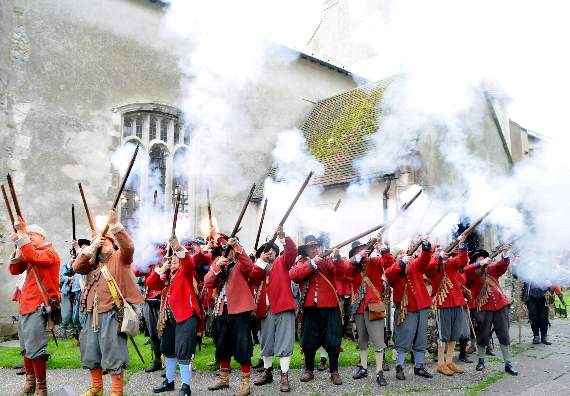
ALTON’S colourful 17th Century history was thrown into sharp relief over the Bank Holiday weekend as thousands flocked to the town to watch a spirited re-enactment by the English Civil War Society of the Battle of Alton.
The Market Square was packed on Sunday for the morning drill, followed at lunchtime by a 500-strong march through the town, led by a small number of mounted cavalry, with onlookers following the pipes and drums to Flood Meadows for the battle.
Aiming to be as historically accurate as time and conditions would allow, the Parliamentarians aimed to recreate the surprise attack in December 1643 when, under the command of Sir William Waller, a 5,000-strong army marched on a bitterly cold and snowy night, following a circuitous route from Farnham Castle, to take the Royalists by surprise.
The Kings Men were holed up for the winter at Amery Farm, close to St Lawrence Church in Alton, and, being out of season, were not expecting an attack. Obviously outnumbered, Lord Crawford and his 300-strong cavalry rode off to Winchester for reinforcements, leaving Colonel Richard Bolles with just a few hundred men to defend his Royal position.



On Sunday, visitors were treated to a colourful and lively spectacle at Flood Meadows, as members of The King’s Army, dressed in authentic costume and wielding weapons of the time, faced up to the burgeoning ranks of The Roundhead Association, fighting with canon, pikes and muskets, amid the pall of smoke and clamour of the battlefield, bringing life to the legend.
As the Royalists were forced back toward St Lawrence churchyard for the final showdown, the huge crowd followed.
There they were able to browse a living history display, with re-enactors demonstrating the life skills needed to live in the 17th Century – from blacksmithing to paper pressing, using the tools and techniques available at the time.
From cooking chicken over an open fire, using imported goods from Italy such as olive oil and rice, to the dentist who explained how it was the “norm” to extract teeth from the dead on the battlefield which, if kept in milk, could be slotted into someone else’s gum, and from the stitching of leather boots to the fashioning of swords, the re-enactors opened a window into the lives of camp followers.
Spectators were then treated to a lively and noisy re-enactment of the storming of St Lawrence churchyard to where the Royalists had retreated, with the Parliamentarians eventually forcing them back into the church itself.
Despite having turned it into a stronghold, using scaffolding to fire from broken windows and dead horses as shields, history tells us that Waller’s men showed no mercy, forcing their way into the church and killing Colonel Bolles as he fought to the end from the church pulpit.
For the re-enactment, it was not possible to go inside the church. Instead the colonel was slain in the church porch, being carried out on a wooden stretcher, covered by a flag, to give the Parliamentarians the end-of-season victory they were determined to achieve.
Re-enactors explained that at the time the population of Alton may have been less than 100. When the Royalists arrived and set up camp they were far outnumbered, and when the Parliamentarian force attacked the town would have been overwhelmed and terrified. There was fighting in the streets and more than half the properties were said to have been burned and ransacked.
Unlike 372 years ago, when appalling weather conditions were used to the attackers’ advantage, on Monday the potential health and safety risks to the English Civil War Society re-enactors and the public, resulting from persistent rain and resulting wet and muddy conditions under foot, put paid to a further re-enactment of the Battle on Flood Meadows.
Instead, visitors were treated to a two-part attack on the Royalists in the churchyard.
While the spectacle was enjoyed by all, the Reverend Andrew Micklefield added a timely reminder that while English Civil War Society members were able to spring up from the battlefield to fight another day, real lives had been lost back in 1643.
Having camped out in the main at Anstey Park, English Civil War Society re-enactors thoroughly enjoyed the experience and expressed grateful thanks for the opportunity to perform in Alton again.
English Civil War Society chairman Phil Davies said: “As usual the response from the people of Alton was outstanding, especially considering the weather on Monday. We are indebted to Alton Town Council, particularly Emily-Jane Messenger, who made it all possible. May the English Civil War Society’s long and happy association with Alton continue long into the future.”
He said that while camping at Anstey Park members had been made “extremely welcome” by Alton Rugby Club who provided entertainment, food and hospitality, all the time served with huge enthusiasm.
And he added: “We are happy to report that no incidents occurred during the re-enactment of the battle scenes. This was largely due to the superb co-operation of all of our marshals from the community.”
Alton Town Council communications and events officer Emily-Jane Messenger said: “We would like to thank English Civil War Society for a fantastic battle re-enactment and Lord Ralph Hopton’s regiment who donated a large amount of the funding in memory of former local member Chris Pullin.
“We would also like to thank the Reverend Andrew Micklefield and his team at St Lawrence Church for granting the use of their grounds and facilities.
“There have been many volunteers involved in making this fantastic event possible for the people of Alton to enjoy, and we would like to extend special thanks to them all for their time, hard work and dedication.”
For more pictures from the Battle of Alton re-enactment, see this week’s Alton Herald.
Comments
This article has no comments yet. Be the first to leave a comment.