
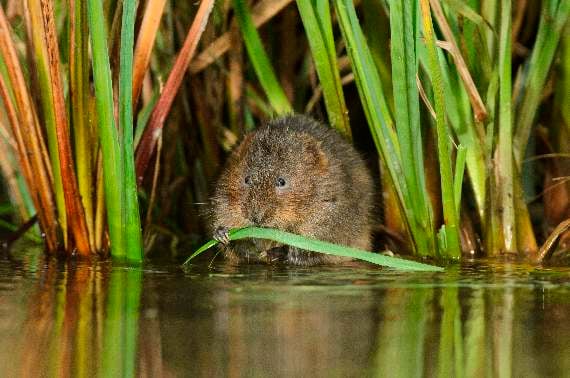
A NEW report released by The Wildlife Trusts paints a bleak picture of the future survival of the water vole as it has been 10 years since this much-loved mammal was officially recorded in Surrey.
The National Water Vole Database and Mapping Project has revealed that water vole distribution has plummeted by nearly a third across England and Wales.
The study analysed data collected by The Wildlife Trusts over a 10-year period, from January 1, 2006, to December 31, 2015, and found a 30 per cent drop in places where water voles were historically found.
Surrey Wildlife Trust is now calling for more funding for water vole conservation projects and for landowners, local authorities and local people to work together to help give ‘Ratty’ a chance of survival.



Water voles used to be seen and heard regularly along ditches, streams and rivers across Surrey.
Jim Jones, living landscapes manager at the trust, said: “Water voles were once the most common British mammal, with eight million in the UK a century ago.
“But they are now our fastest declining mammal and we fear they are probably functionally extinct in Surrey.
“This is a terrible shame and while The Wildlife Trusts and others are working hard to help bring them back again and care for the places that they need to survive, much more work is needed if we’re going to stop this charming creature disappearing altogether.”
Not to be confused with rats, water voles are a similar size and brown in colour, but with a blunt nose and rounded face, a furry tail and small ears.
They burrow in river banks and feed on reeds and grasses, often leaving piles of cigar-shaped droppings, nibbled vegetation and star shaped footprints.
It’s believed the main reason for the dramatic decline of the species in Surrey is due to the widespread destruction and degradation of wetland habitats and the populations of non-native American mink, which prey on water voles.
The Trusts’ ‘Surrey Water Vole Recovery Project’ trained volunteers to carry out specialist water vole studies, searching for signs of the species.
Since 2015, around 100 surveys have been carried out across six different river catchments in the county, but sadly not one water vole was found.
While Surrey has no recorded water voles, neighbouring counties Hampshire, Sussex, Kent and London do have populations, some of which are a result of reintroduction projects.
Surrey Wildlife Trust has also been working with volunteers as part of its RiverSearch citizen science project to restore and conserve riverbank habitats.
It’s also been advising landowners on river and ditch management to benefit water voles.
Mr Jones added: “We need to continue to survey locations across Surrey for water voles to confirm our initial findings.
“If voles are indeed functionally extinct, we would love to reintroduce them in Surrey sometime in the future but this is a major undertaking and would need considerable funding.
“In the meantime we will continue to work with volunteers, landowners and other partners to improve wetland habitats for water voles.”
To help water voles and other wildlife, sign up as a volunteer with the Trust, become a member or -make a donation at www.surreywildlife trust.org.
Keep an eye out for water voles and report any sightings to the Surrey Biodiversity Information centre by emailing surreybic@sur
reywt.org.uk.
Comments
This article has no comments yet. Be the first to leave a comment.