
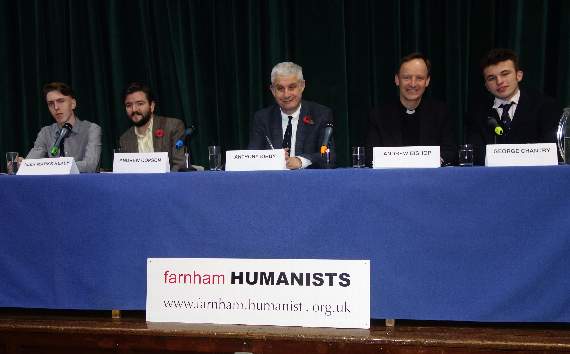
SHOULD Britain stop acting as if it were a Christian country? This was the question debated by the panel and audience of more than 90 people at a lively public debate on the motion ‘Britain is no longer a Christian country and should stop behaving as if it is’ hosted by Farnham Humanists.
The debate centred around what was meant by a Christian country. Does a culture make a country Christian or does it need actual church attendance? And what would not behaving like a Christian country entail?
Andrew Copson, chief executive of the British Humanist Association, spoke first in favour of the motion. He said church attendance was minimal and had halved in 30 years.
He argued the country no longer held the basic Christian beliefs and Christianity was not part of people’s identity, it was no longer the port of call in times of crisis or celebration.


He acknowledged that today’s society was partly shaped by Christianity but that much was pre-Christian.
According to the group this all mattered for three reasons. Firstly truth matters, myths can inhibit non-religious beliefs and prevent beneficial changes to laws.
Secondly, it is alienating for non-believers and thirdly, it is internationally harmful, as the country requests to other countries that they should have religious freedom are viewed as hypocritical.
Opposing the motion was Reverend Canon Dr Andrew Bishop, Residentiary Canon and Anglican Chaplain at the University of Surrey. He said that Christianity arrived in Britain in 304 AD and was deeply interwoven into its history.
For him, it formed the basis of the relationship between state and people and acted for the common good. Christians had fought against the slave trade and worked against deprivation.
Alex Marks Healy of Guildford County School Secular Society next supported the motion. He asked what being a Christian fundamentally meant.
George Chantry, an Oxford University PPE student, then seconded the opposition to the motion. He said that so much of England’s culture is of Christian origin, developed over 1,500 years, that it can’t be reversed overnight.
There were many contributions from the floor from an involved and interested audience. The time allocated for summing up was shortened to cater for the number of people wishing to raise issues.
In his summing up, Andrew Bishop said that he doesn’t regard the state’s role in religion as being essential to Britain being a Christian country, he himself was in favour of disestablishment.
The meeting was chaired by Anthony Kirby, a history and politics tutor at Godalming College. The motion was carried by 53 votes to 23, with eight abstentions.
Six people indicated that they had changed their mind during the debate.
Entry to the debate was free but a charity collection at the end raised £185 for Disability Challengers.
Comments
This article has no comments yet. Be the first to leave a comment.