
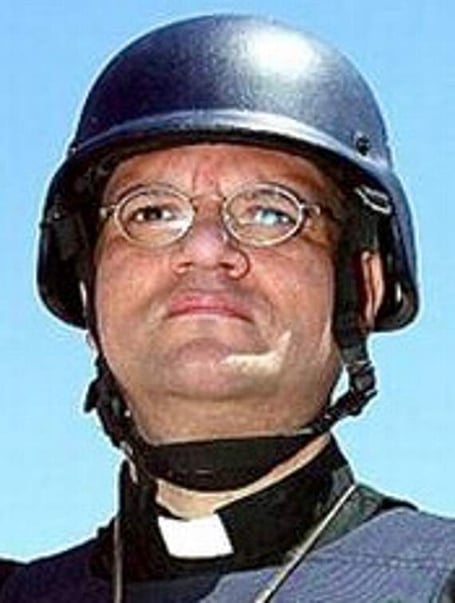
CANON Andrew White has been suspended from his position as president of the Foundation for Relief and Reconciliation in the Middle East (FRRME) after the Charity Commission started an investigation last month.
The former Vicar of Baghdad was suspended from his own charity after “helping” to free sex slaves from so-called Islamic State – but questions have been raised about how their release was achieved.
Canon White wrote on his Facebook page last year that FRRME was involved in working with “women and girls who have been rescued as sex slaves”.
On June 23, he addressed his suspension with a second statement, also on Facebook: “As you may have heard I have been suspended from my role as president of FRRME.

“This is in response to some inaccurate statements I made about our work with and funding for the former slave girls taken by ISIS. What is clear is that at no time did we pay money to any terrorists.
“While I cannot work on behalf of the FRRME, I continue to lead worship and support individuals that we are helping. Please pray for us at this very difficult time.”
The FRRME board of trustees responded with its own statement, which read: “The Reverend Canon Andrew White has been suspended with pay ... pending the findings of a Charity Commission inquiry.
“The foundation is co-operating fully with the appropriate authorities. This is a temporary suspension, pending the outcome of the inquiry.”
It is understood concerns were raised over alleged ransom payments to secure the release of girls held as sex-slaves by Islamic State, which would be unlawful under English law.
When Canon White founded the charity in 2005, he was chaplain of St George’s Church in the Iraqi capital Baghdad.
The FRRME website states it provides emergency relief to Christians and other persecuted minorities in northern Iraq, as well thousands of Iraqi refugees who have fled to Jordan to escape the sectarian violence.
In addition to spiritual support, FRRME provides food, medicine and shelter and works with partners on the ground, including churches, government organisations and the UN to ensure aid reaches the most vulnerable.
FRRME’s reconciliation work is focused on the peace process in Israel and Palestine. As well as supporting grassroots organisations, the charity runs an annual summer school – The Jerusalem International School for Reconciliation – which introduces a new generation to the power and methods of reconciliation.
Canon White, 52, who has been tirelessly campaigning and fundraising for FRRME, added: “As I often say, we must pray for peace but we must also pay for peace.”
At the age of 33, he was appointed a canon at Coventry Cathedral as well as being diagnosed with multiple sclerosis, which affected his mobility and speech.
He became the director of international ministry at Coventry heading the International Centre for Reconciliation across the globe.
After concentrating on the Middle East, he moved to Baghdad in 2005 to become the Anglican chaplain for St George’s Church and helped to establish St George’s clinic, where he has regularly been undergoing a new stem cell treatment for multiple sclerosis.
In November 2014, after nine years in Baghdad, the Archbishop of Canterbury, Justin Welby, ordered the canon to leave owing to the increased security risks and the Church of England’s own no-hostage policy.
Canon White (pictured) has mediated in the release of many hostages, including the late Jaweed Al-Ghussein, chairman of the Palestine National Fund, who was kidnapped from Abu Dhabi with the compliance of Sheik Hamadan Bin Zayed and Sheik Seif Bin Zayed.
Denied access to the Red Cross in Gaza, Canon White was able to visit him and eventually through his position as special envoy mediated Jaweed Al-Ghussein’s release back to the UK.
He also played a key role in negotiating the end to the Bethlehem siege in 2002, and took part in the Alexandria Process to build understanding among different faith leaders and work toward peace in Israel and Palestine.
In 2004, he hosted the Baghdad Religious Accord which led to the establishment of the Iraq Centre for Dialogue, Reconciliation and Peace. In 2011, he chaired a summit of Iraq’s religious leaders in Copenhagen, which produced the first joint Sunni and Shia fatwa against violence in Iraq.
Canon White’s main aim has been to try to maintain communication between Shia and Sunni leaders and to gain trust of key religious leaders on both sides in various conflict areas.
In May 2014, Canon White was awarded the William Wilberforce Award in Washington DC for exemplifying the passions and principles of William Wilberforce as a witness of real Christianity in society. He became the first Anglican priest to win the award, which is given for statesmanship and spiritual leadership at an international level.
In December of the same year, he was made an Honorary Doctor of Divinity by Wycliffe College, University of Toronto. In January 2015, Canon White was voted top in the Archbishop Cranmer’s top 100 UK Christians. His autobiography – entitled My Journey So Far – saw him embark on a UK book tour late last year.
He has struggled in his battle with multiple sclerosis after the regular stem cell treatments he had been pioneering in Iraq stopped when he was forced to leave the country after death threats from Islamic State.
Comments
This article has no comments yet. Be the first to leave a comment.