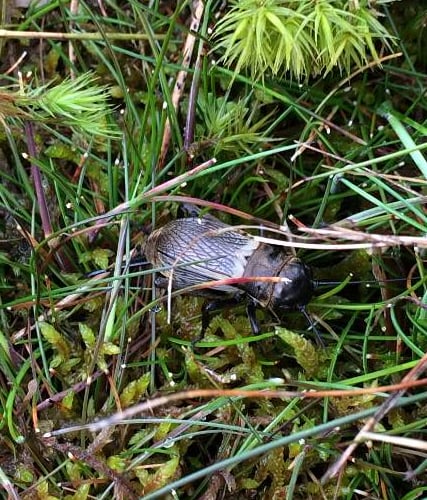
A COLONY of endangered crickets at the RSPB Farnham Heath reserve is set to benefit from a new National Lottery-backed conservation project.
Called Back from the Brink, it aims to save for future generations 200-plus scarce and threatened UK species. It is the first nationwide coordinated effort to bring a wide range of leading charities and conservation bodies together to save threatened species.
In one of the most ambitious conservation projects ever undertaken, Back from the Brink will address the needs of threatened species in 150 key habitats and landscapes across England from the Yorkshire Dales to Cornwall and in Surrey and Sussex.
Awarded £4.6 million by the National Lottery, in the South East this funding will help the RSPB manage sensitive habitats for two endangered species already found on the RSPB’s Farnham Heath and Pulborough Brooks nature reserves.


At RSPB Farnham Heath, adjacent to the Rural Life Centre in Tilford, a small field cricket population was successfully established on an isolated area of restored heathland through translocation in 2010/11 and is now one of the largest field cricket populations in the UK.
The project will help strengthen this population by trying to establish a second colony on a different part of the heath.
The field cricket, or Gryllus campestris, pictured below, is the most endangered true cricket species in Britain. Unlike most other crickets or grasshoppers, field crickets are flightless, so are unable to migrate long distances between fragmented habitats as they have to walk everywhere.
It formerly occupied grassy heaths within an area of Surrey, Sussex and Hampshire with a localised distribution bounded to the east by the River Arun, to the west by the Solent, to the north by the North Downs and to the south by the Isle of Wight.
But over the last century it disappeared from most of its historic range, due to loss of heathland resulting from changes in land use including afforestation.
For those fragmented heaths that remained, lack of disturbance by livestock and increased rates of succession meant that many of them were unable to support field crickets. By 1991 the species was confined to just one site in West Sussex (Coates Castle/Lord’s Piece) with fewer than 100 individuals and was expected to go extinct within the UK.
Thanks to a programme of reintroductions which commenced in 1992, it is now breeding at six locations across Surrey, Sussex and Hampshire but is still vulnerable at many of these sites due to their isolation and lack of guaranteed management. This is where Back from the brink comes in.
There are also plans to establish a population at RSPB Pulborough Brooks reserve, by introducing young from population at Parham Park, which is adjacent to the reserve.
The West Sussex reserve will also receive funding to help bolster one of the UK’s three remaining breeding populations of the 5mm-long lesser whirlpool ramshorn snail with carefully managed drainage ditches to help it breed successfully.
Other rare and elusive species set to benefit from the project nationally include the shrill carder bee, chequered skipper butterfly, ladybird spider, northern dune tiger beetle, long-eared bat and pine marten.
Natural England, the government’s wildlife advisory body, will work in partnership with and the RSPB, Amphibian and Reptile Trust, Bat Conservation Trust, Buglife, Bumblebee Conservation Trust, Butterfly Conservation and Plantlife to pool expertise, develop new ways of working and inspire people across the country to discover, value and act for threatened animals, plants and fungi.
The programme also aims to inspire the nation to discover, value and “act” for threatened species and take steps to help them and will:
• Safeguard 20 species from extinction;
• Directly improve the conservation prospects of a further 200;
• Recruit and teach more than 5,000 volunteers new skills to study, identify and care for threatened species; and
lEngage with landowners and communities to deliver conservation at 150 different locations across England.
Mike Clarke, the RSPB’s chief executive, said: “Our natural world is in trouble, last year’s State of Nature report revealed the population of over half of UK species are in decline, but we believe it is not too late to take action.
“Today’s announcement by the National Lottery will make a big difference to some of our most threatened species that, without
swift action, may very soon be lost forever.”
Comments
This article has no comments yet. Be the first to leave a comment.