
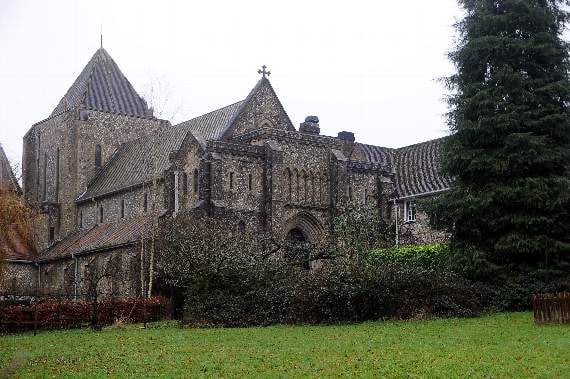
THE monks of Alton Abbey may not be like their medieval predecessors, living a frugal life of fasting, hair shirts and cloistered in dark, stone cells, but they share the same dedication to God, keep to a strict routine of prayer and meditation, and with a life commitment to their vows.
They follow the rule written by St Benedict in Italy in 480AD, which spread worldwide and beyond the Roman Catholic denomination; Father Andrew, who is Prior of Alton Abbey, said: “Benedictine monks can be Anglicans, as we are here, or Lutheran, Methodist, Catholic or Greek Orthodox.”
At the entrance to the flint and stone-built Abbey, set in 40 acres of beautiful grounds, is a large sign saying ‘welcome’ and this is the essence of this building, designed by Sir Charles Nicholson, for as Father Andrew says: “We offer friendship and hospitality in place of Christ as he would have done.”
The Community of Alton Abbey, which sits at the top of Kings Hill in Beech, was founded by Reverend Charles Polmer Hopkins in 1884 in Burma as the Society of Saint Paul to work with destitute or distressed merchant seafarers and their chaplains.
 The best festive winter walks to enjoy in the South Downs National Park
 Dream of a white Christmas denied in Surrey and Hampshire
 Rise in hospital admissions for stress and anxiety in east Berkshire, north east Hampshire, Farnham and Surrey Heath
 Rise in hospital admissions for stress and anxiety in Surrey Heartlands
The first house in the UK was opened in 1894 in Barry Dock, South Wales, but a quieter house was needed and the site at Beech was bought in 1895, caring for retired or ill seamen in temporary wood and metal buildings.
The monks did most of the construction of the Abbey but out-of-work sailors, prior to the First World War, helped to build the Abbey Church, designed by Cyril Hawes and dedicated to Our Lady and Saint John.
In 1989, another charity took over the Society’s work with seafarers and now the Abbey runs retreats and occasional icon painting courses.
These are run by Dom Anselm, who has created the stunning icons that can be seen in the church and in the cloistered abbey.
Father Andrew, who at the time of the interview was acting on behalf of the abbot, Reverend Dom Giles Hill, recovering from an operation, has been at the abbey since he joined the order in 1985 and has never had any doubts he chose the right path in life despite being brought up by parents who were atheists.
“I knew it was right for me,” he said. After first being an aspirant, postulant and novice, then taking vows of stability, conversion of life and obedience for a three-year period, he took his lifetime vows at the end of five years, gaining the title of Dom and also a lifetime commitment to Alton Abbey.
He explained “We always stay in the place where we first joined the order as each Benedictine community is its own enclave.
“Benedictine monks lead a celibate life but unlike Roman Catholic priests who must agree to that before they can be ordained, we choose to commit to it,” he said.
Father Andrew is humble about his calling and has a dry sense of humour which punctuates his conversation, such as when describing how monks, in their black robes, fitted into 21st Century life.
“We are just human beings who wear frocks, and we never have the problem of what to wear,” he laughed.
However his robes can be a bit off-putting to some for when he is out and about “I find either people want to come and talk to me, or they cross over the road. After all, its understandable, we are all different”.
Also, even though they are dedicated to a life of gentle religion and God, he admits living in an all-male community with fellow monks can sometimes cause tension.
“Occasionally we do fall out with one another but you have to work it through and we always do.”
As with monks through the centuries, those at Alton Abbey follow a strict daily religious routine where they meet for prayers and meditation four times a day from early morning to evening, as well as attending a daily mass in the church.
“It can be very cold in the winter,” Father Andrew admits, “but it is heated when the public come to our services.”
Also, except when the monastery closes for retreat there are six services, beginning with morning prayer open to the public each day, and “all are most welcome”, he said.
The monks do have some comforts, such as television, newspapers and computers, and they have three meals a day which they eat together in the large refectory.
“We are allowed a glass of wine with our dinner on Sundays and also on special occasions,” he said.
They don’t make “house calls” unless it is someone long connected with the abbey who is bed-ridden but people are welcome to come and talk with the monks about anything that is worrying them, although it is best to make an appointment first.
“And we will listen, but we don’t tell them what to do. We try to help them work the problem out for themselves.
“Everyone is also welcome to come and sit quietly in the tranquillity of our church, which can often help them.”
Although Alton Abbey is very much its own community run by the abbot it is subject, rather like schools, to an Ofsted inspection by the bishop every five years.
“But we are not put in special needs or anything like that if we fail,” he laughed. “The report will just give suggestions on improvements needed, if there are any, and on things relating to community and church life.”
Although dedicated to life in the abbey, the monks are allowed a yearly holiday to go away or to visit family and friends.
Father Andrew has a great interest in the First World War and the war graves in France and Belgium; he often spends his holidays visiting them.
His interest is also prompted by the abbey’s own war hero, Brother John, who joined the order in 1895 and was a man with many gifts which he used to improve life in the community before enlisting in the First World War and being killed in action in 1917. He was awarded the Military Cross for bravery.
Now a hundred years on since that tragic death, the Abbey, itself 122 years old, with extensions that have been added since it was built, are in need of some TLC.
“Heating it costs a fortune,” said Father Andrew, “and we can’t afford double glazing. There are some repairs to be done but the only income we have is from our retreats, the sale of icons and the events, like small fetes, we hold in the grounds – together with the kind donations of our regular congregation and other friends.”
The other problem is the decline in the number of monks at the abbey. There are just six and only four are life members. If they choose, monks can leave after five years without taking their final vows, and Father Andrew is the youngest of the Life Professed. “Yes,” he smiles, “we could do with some more recruits.”
Judging from the happiness Father Andrew radiates, as only a man who has found his calling can, and the peace you feel when you enter the abbey and its church, anyone who feels they have a vocation to devote their life to God would do well to think about joining this small enclave of Benedictine monks.
Comments
This article has no comments yet. Be the first to leave a comment.