
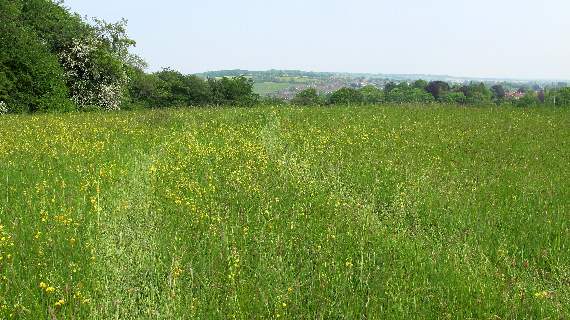
THE controversial South Alton Plan sparked yet more outrage this week after the Treloar butterfly meadow was sprayed with herbicide.
Just two years after the launch of an online petition to save the species rich chalk land habitat, the unimaginable has happened and the once burgeoning wildflower meadow has become a sea of dying plants.
While the landowner, the Government-run Homes and Communities Agency, has given an assurance that the herbicide used was targeted at ragwort and will not affect any insects or orchids, Save Alton’s Butterfly Meado’ campaigners are “devastated” by what they fear is deliberate “sabotage” of an area designated for future use as a country park.
From a public confidence point of view, lack of warning could be seen as an own goal for the Homes and Communities Agency which gained planning permission to build 280 new homes on the 28-acre site adjoining Treloar Heights in February last year, part of which will encroach on meadowland bordering Ackender Wood. Due to its sensitive nature and in a bid not to breach the skyline, a condition of planning was imposed for just under 20 acres of the meadow to be given over to country park, which will eventually be handed over to Alton Town Council.




Enjoyed by townsfolk for generations, it is a grassland site that has been described by a Hampshire Wildlife Trust representative as a “precious and rare habitat” which is said to be home to five types of orchid, including the rare bee orchid, and to the small heath and small blue butterflies – both listed under the UK Biodiversity Action Plan as a species in decline and in need of protection. More recently, a patch of white helleborine orchids, red listed by the UK Biodiversity Action Plan as “vulnerable”, have also been discovered on the site.
Campaigners have fought hard to retain the hillside meadow, which is clearly visible from vantage points around Alton and offers panoramic views across the town and surrounding countryside. They suffered a real scare with the discovery of Japanese knotweed on part of the site in 2014, but the Homes and Communities Agency took action to eradicate the plant.
This time it is the threat of ragwort that has triggered the spraying of herbicide across the wildflower meadow, albeit avoiding the perimeter so as not to contaminate residential gardens or SINC areas.
In a statement, the Homes and Communities Agency explains that as a condition of planning it is committed to providing a country park area with public access. However, until such time as the 280 homes have been built on the adjoining site, and in order to minimise costs to the tax payer the meadow is let on an annual basis for agricultural purposes.
The statement continues: “The tenant identified that ragwort was growing on the land. This weed is toxic to cattle and horses and to prevent them being poisoned the tenant took the appropriate action. It has been confirmed to the Homes and Communities Agency that a herbicide, which does not affect any insects or orchids, was used to control the ragwort and other weeds growing in the grassland.”
Leading Butterfly Meadow campaigner Ginny Boxall has been angered by the response, pointing out that the “so-called weeds are actually wild flowers and provide much-needed nectar for the many bees and butterflies on the meadow, so I would strongly refute their claim that it hasn’t harmed the insects”.
Mrs Boxall also believes it is too early to know if the orchids have been affected as they won’t be out till late June or July.
She further contends that the ragwort was “very sporadic” and could have been hand pulled and that there was no need to spray the entire meadow.
“It’s killed the wild flowers – clover, buttercups and oxeye daisies, which are wilting and dying, not just ragwort.”
Having closely monitored the situation, according to Mrs Boxall, the meadow has not been sprayed for at least 10 years and a hay crop has not been harvested for several years but just mown and left. Her fear is that, if another ecological survey is carried out now the meadow could lose its species-rich status, leaving it vulnerable to calls for future development.
But it has been the unexpected discovery of the state of the meadow after the spraying that has sent shock waves through the community. According to Mrs Boxall, a landscape photographer, she last week sent a picture of oxeye daisies in the butterfly meadow to both Meridian and South Today television news stations. Two days later, they had been destroyed by spraying.
“I could weep at this wanton destruction,” said Mrs Boxall, whose sense of disbelief has been reflected widely on social media and by supporters such as celebrity gardener Alan Titchmarsh.
On a more positive note, while not able to comment specifically, a spokesman for Butterfly Conservation points out that taking a hay cut is good management for the biodiversity of a meadow.
She suggested that if in previous years the meadow had been cut but not baled it could indicate insufficient grass which could have resulted in target spraying this year, from which flowers such as clover should recover.
Comments
This article has no comments yet. Be the first to leave a comment.