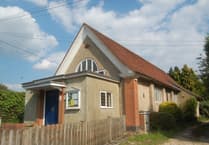
A DISCOVERY centre for Whitehill and Bordon could be one step closer after a meeting at the Forest Centre in Bordon last week. The discovery centre concept is still relatively new. Much like a museum, each centre is tailor-made to the local community and designed to meet a range of community needs in one building. For example, a discovery centre can combine museums and libraries with other facilities, such as a local records centre, a family history section, a café, a computer suite, an art gallery, and study areas for schools. The meeting involved interested parties from the town's museum project, Hampshire county libraries and the county council's recreation and heritage team. It was also well attended by community groups, including representatives from Woolmer Forest Heritage Society, town, district and county councils, the town partnership, the Phoenix Centre, the National Trust, Mill Chase School, the Youth Umbrella Group, Walldown Preservation Society and the Deadwater Valley Trust. The museum project and heritage society chairman, Joan Martin, said: "Although we have an excellent display cabinet in Bordon library, our immediate problem is to find premises to store equipment, process finds and receive school groups. "Our ultimate goal is to set up a museum or discovery centre to help unlock this area's nationally important archaeology and internationally important wildlife and landscape heritage." The Whitehill-Bordon museum case was opened in Bordon library in 2004 by the Lord Lieutenant of Hampshire, Mary Fagan, and features new displays casting light on local history on a regular basis. Woolmer Forest Heritage Society believes the Whitehill and Bordon area is of vital importance and, consequently, it should be celebrated. The Whitehill-Bordon area is steeped in history long pre-dating the arrival of the Army a little more than100 years ago. Middle stone age flint tools of national importance have been unearthed locally, as have bronze age swords and spears, which were thrown into lakes as offerings. Local county councillor Adam Carew said: "The area has possibly the highest concentration of bronze age round barrows in western Europe. These high-status burial mounds indicate that the place was once very sacred. "There is also a possible iron age hill fort, a deserted mediaeval village, a civil war encampment, water meadows, ancient woodland and, of course, strong connections with Gilbert White. "The Whitehill-Bordon area is also noted for its internationally important wildlife; for example, it is the only place in the whole country to have all 12 species of reptiles and amphibians, and it contains the largest ephemeral lake in western Europe." Speaking about the meeting, Mr Carew, said: "It was highly productive. "There is still a long way to go, but we are looking into a range of options with the support of the county council's recreation and heritage team. "This is a very exciting project. I think a new museum or discovery centre fits in well with our green town vision and will give this community a real sense of its own importance." Local archaeologist David Graham explained why the area is unique. "The archaeology for this area is different from the rest of Hampshire because of the different geology of the Weald," he said. "The Whitehill and Bordon area seems to have been very sacred 4,000 years ago. There are 51 bronze age round barrows and three disc barrows in the area - one of the densest concentrations in the UK. "These high-status burial mounds sometimes contain cremations or remains of important people, for example, chieftains. "There are also three probable settlement sites which have produced finds of pottery." He added: "A Roman road crossed the area and two hoards have been found, one of which contained 30,000 Roman coins. "There was probably a villa to the south of Whitehill, while to the north, kilns form one of the largest concentration of Roman potteries in Britain. "Saxon influence was shown in place-names such as Headley and Wulvamere, in other words, wolf's mere or Woolmer. "Medieval records included water-mills, hunting lodges, deserted mediaeval villages a moated site and settlements carved out of the royal hunting forest of Woolmer. "The military involvement from 1850s has left training sites from preparations for the Boer war as 'lumps on the commons', and more recently, we have the history of Longmoor Railway." Mr Graham outlined the history of the area at the meeting in order to show how strong the need is for a museum or discovery centre in the area. He said: "A museum or discovery centre would allow the community and visitors to understand their rich and nationally important past. "It would give the area a sense of local pride and place."