
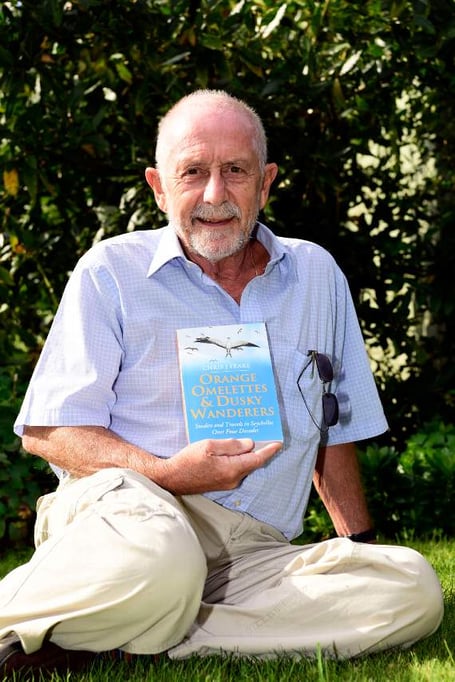
A COMMITTED ecologist describes his enduring fascination and hopes for his “beloved” sooty terns after studying the tropical seabird over four decades in Seychelles in his latest book, Orange Omelettes and Dusky Wanderers.
Chris Feare’s career has been devoted to research on birds that interact with man’s interests in the form of conservation problems or in posing threats to human livelihoods and safety.
He first visited Seychelles in 1971, living there for two years to undertake research on Sooty Terns and the effects of commercial harvesting of their eggs.
This led to a lifelong interest in the unusual species of bird and other seabirds, and to his enduring love of the islands.




For more than 40 years he has travelled widely in Seychelles and witnessed remarkable changes, affecting both birds and humans.
As Chris, from Grayswood, explained, his “dusky wanderer,” the sooty tern, faces four major threats
• Global warming and the threat of sea level rises
• Over-exploitation of tropical fish stocks on which the bird depends
• Habitat changes on nesting islands due to expanding human populations; and
• Depletion of nesting colonies due to the speckled eggs being regarded as a seasonal delicacy.
“After a very long gestation period, my book has now been published,” he said.
“It describes my experiences in Seychelles from late 1971 to the present.
“Based around the biology of my beloved sooty terns, it also embraces other areas of conservation in Seychelles, illustrating the leading role that Seychelles is playing in the conservation of a wide range of endemic and indigenous island wildlife. This is set against a background of economic development, which can also have negative environmental impacts.
“Accounts of travel among the islands, including the central granitic islands and many of the remote outer islands with difficult and sometimes hair-raising access, are described, linking where possible their current state with various forms of exploitation in the past.
“This ‘past’ is short, however – the time that has elapsed since the first human settlement is a mere two-and-a-half centuries.
“But this time has been sufficient for man to inflict huge changes to the ecology of many islands and some of the changes may take centuries to ameliorate.
“All conservation and island rehabilitation efforts come into conflict at some state with perceived development needs, which continue to proceed apace, but as more Seychellois become aware of their unique environments through education and experience, there is room for optimism, with current conservation successes illustrating clearly what might be achievable.”
As head of the bird department in the Department of Environment and Rural Affairs for 21 years, he researched the management of wild birds for conservation and pest control.
Chris then took early retirement in 1996 and co-founded WildWings Bird Management, a research resource and consultancy in the management of wild birds for conservation and pest control.
A new chapter in his life began with a request from the director of conservation in the Seychelles government in 1992 to begin further research on the Sooty Terns, which led to annual visits that have informed his vivid and authoritative account.
Determined to secure the long-term survival of his “dusky wanderer”, but fearful for its future, Chris writes: “It seems to me doubtful, despite the greater than anticipated adaptability revealed here, that what is probably the world’s most numerous tropical seabird will come out of the anticipated environmental change unscathed.”
• Copies of the book are online at www.nhbs.com.
Comments
This article has no comments yet. Be the first to leave a comment.