
ALTON has a new blue heritage plaque, erected on the wall of 100 High Street (now Downie & Gadban) in honour of Peter and Iona Opie - a remarkable husband-and-wife team who used rhymes and playground games to explore the law and language of school children.
The couple, whose sons James and Robert were at the plaque unveiling on November 17, lived in Alton between 1949 and 1959, during which time they produced some of their finest work.
Iona was a researcher and writer of European folklore and children’s street culture. She was considered an authority on children’s rhymes, street and playground games and the Mother Goose tradition.
Husband Peter was a specialist in children’s literature and the customs of schoolchildren.

The couple met and married during the Second World War and worked together closely, conducting primary fieldwork, as well as library research and interviewing thousands of children.
In pursuing the folklore of contemporary childhood they recorded rhymes and games as they were being played. They collaborated on several celebrated books and, combined, produced more than 30 works.
They were jointly awarded the Coote Lake Medal in 1960 by The Folklore Society “for outstanding research and scholarship”.
The plaque was unveiled by Alton’s deputy town mayor, Allan Chick, who was joined for the short ceremony by the Opies and Alton resident Jean Goodwin, who remembered, as a teenage shop assistant, selling toys to James and "little Bobbie".
Mr Chick recalled their mother, Iona, spending an evening at his home discussing education.
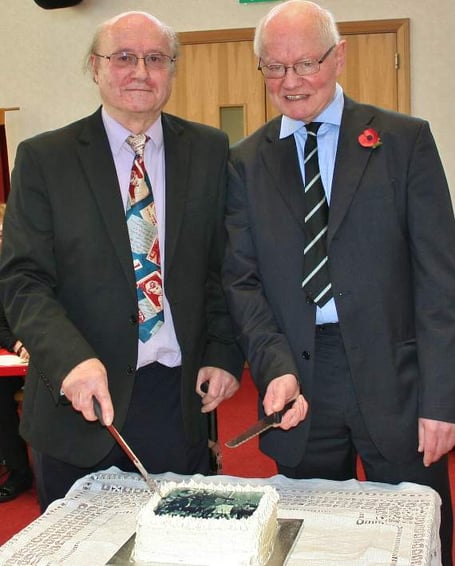
The Opie brothers then treated guests to a series of happy memories of their childhood in what they described as “a delightful and very happy little town” before cutting a celebratory cake, iced and decorated with a photograph of Peter and Iona Opie in a school playground learning a skipping game.
The importance of Anstey Junior School in the Opies’ story was then taken up by headteacher Jenny Jones who explained that, while much of the Opie researches into children’s songs and games extended worldwide, Anstey - the latest in school design when it opened in 1957 - was the location for much of Iona’s work.
Mrs Jones was then joined by present pupils to reenact rhymes, riddles and counting games used by the school’s first pupils 60 years ago and included by the Opies in their classic The Lore & Language of Schoolchildren, which was written in Alton.
Former Alton headteacher Luath Grant Ferguson, an admirer of the Opies’ work who made extensive use of rhymes and music with young children attending Bushy Leaze, spoke briefly about the importance of enabling children to learn and enjoy not only the practical everyday way we speak, but also the magical language which exists in fairy stories and nursery rhymes.
A fan of another Opie masterpiece, The Singing Game, he told guests he had lent a copy to his friend, Philip Andrews, the local composer whose music was played at Buckingham Palace earlier this year, with the suggestion that he might see what the Opies had to offer to inspire some music for the unveiling.
“Within a month,” said, Luath, “Philip had composed a wonderful piece for the occasion based on six traditional songs once heard sung by children playing in the street, in the playground, or even after the war on the many bomb sites. Some of them are still heard today!”
He went on to introduce Ancora, Alton’s creative ladies’ voice choir and its director, Lii Carr, who were there to give Philip Andrews’ piece, which he has called Singing Games Suite, its first and, as it turned out, colourful and lively performance.
Comments
This article has no comments yet. Be the first to leave a comment.