
WHEN the second wave of Covid-19 hit, UK schools were once again told to close to the majority of their students and had to transform their way of working.
At Farnham Heath End School, teachers switched to delivering remote lessons via the online platform Google Classroom, largely working from home.
The school’s associate staff are busy on site supervising students classed as vulnerable or whose parents are key workers.
And like all secondary schools, FHES had to set up a Covid-19 testing facility. In the first of a two-part feature, we hear from staff how they have risen to the challenge.


.png?width=209&height=140&crop=209:145,smart&quality=75)
PRINCIPAL STUART MAGINNIS
“I had mixed feelings when the announcement about further school closures was made in December. Initially, I was upset that students would again miss a significant amount of time from school.
“However, I was also excited about the prospect of seeing the fruition of what we had learnt from the first lockdown. We have made a significant investment in staff training and our new digital strategy which included the introduction of a Chromebook one-to-one scheme.
“Since our return I have been immensely proud of everyone in our school community. As a team we have set up a mass Covid-19 testing centre at school, provided face-to-face provision for the young people whose parents are key workers, and also met the new challenges of remote learning.
“The vast majority of our teaching team are working from home and delivering lessons remotely. This ranges from live lessons, pre-recorded tasks and resources on our remote Google Classroom platform. Like most of the nation we still suffer with ‘you’re on mute’ issues of video lessons!
“Our students have been so resilient and the level of engagement has been superb. We continue to deliver to our school timetable, which includes assemblies and tutor times. Just like the first lockdown we have also maintained the challenges to keep our fun spirit alive.
“As a leader in education it has been a challenging year but with my fantastic team, I am delighted to see the continued growth of the young people of Farnham Heath End School. We look forward to coming out of the lockdown in the coming months and see our school continue to develop and flourish.”
MIDDLE LEADER LAURA MENAGH
Laura Menagh is head of Year 7 which has an intake of 221 students. Of those, approximately 35 are in school at the moment.
Most days, Laura is on site overseeing those students and the rest of her year group who are working remotely.
She combines this role with teaching maths to Years 7 to 9.
“I have been impressed by how well the Year 7s have adapted to remote learning; they have really taken it in their stride.
“The day starts with a live tutor time where we check in and do activities with the students and they have the chance to see their friends.
“We have assemblies and discussions. We are trying to keep a sense of normality for them. Then it’s on to lessons where they have had to learn new skills like joining Google Meet for a live lesson and uploading their work on Google Classroom.
“In my live maths lessons, it’s good to see students getting more confident; they are coming off mute and participating.
“The students have all adapted so well to remote learning but there is nothing better than being in a classroom and I do hope to see them all get back into school soon.”
TEACHER HESTER BENHAM
Hester Benham teaches physical education and is a Year 10 tutor.
“The progress we have made as a staff since the first lockdown is amazing. That progress has been supported by our transformation into a Google school. The remote learning we are offering to the students now is phenomenal.
“For teachers, planning has to shift because the way we engage with the students, live or remotely, is very different.
“The planning is more time consuming. It is really key to make sure the instructions for students are very clear. We need to track and log the work done and provide feedback to students.
“We also have our pastoral duties to check on our students’ welfare. Most of us are tutors and we run tutor sessions in the mornings and make weekly phone calls.
“Initially, those calls are to students who are struggling with remote learning but eventually we call all students in our tutor groups, to check in with them during lockdown.
“Generally for teachers the admin has increased and their days are longer. It is incredibly hard but I think our students are making it easier: their engagement has been amazing.”
COVID-19 TESTING
Shortly before breaking up for Christmas, secondary schools were instructed by the government to set up on-site testing centres to administer lateral flow Covid-19 tests to students and staff.
The rationale behind this was to enable more students to stay in school when positive cases were identified.
Instead of being sent home to isolate for ten days, contacts of the positive cases would be tested daily.
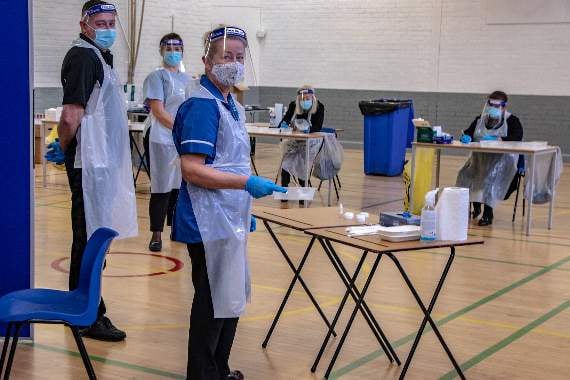
FHES appealed to its associate staff for volunteer testers and was lucky as in that staff group there were three former nurses, including the school nurse.
A testing team was mobilised and they carried out the national online training on the first day of term. By the afternoon of the first day of the spring term, a gym had been transformed into a testing centre and staff were being tested. The next day, student testing started.
Then came the government announcement that secondary schools would be closed until February half-term to all but the children of key workers and students identified as vulnerable.
That reduced the scale of the FHES testing operation but testing was still mandatory for students and staff on site. The team has been testing every morning since term began.
Former mental health nurse, teaching assistant Jakki Kelly, said: “When the call went out for testers, I didn’t hesitate to volunteer. I was confident I had the skills. It didn’t take long to get into a good system with us all working in our respective different roles.”
Former intensive care unit nurse Annette Pelling, now a teaching assistant, said: “It’s very straightforward – 99 per cent of students have been fine and have had no issues with it. If they have concerns, we talk it through.
“They have coped very well, with some year groups coming for testing every day when there has been a need.”
Comments
This article has no comments yet. Be the first to leave a comment.