
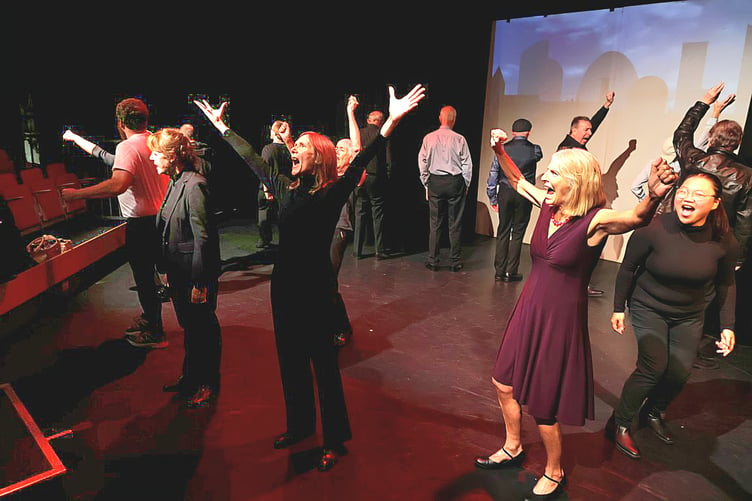
Anyone familiar with Alton Fringe Theatre expects the highest theatrical standards and Shakespeare’s Julius Caesar was no exception.
Director Steve Gerlach wanted to make the play relevant to a modern audience - and its regime change, narcissistic, boastful rulers, corruption, mob rule and mindless violence continue to dominate politics today.
The music began with a Bob Marley track about fickle and duplicitous friends. Four choir pieces by Mike Orchard intensified the atmosphere - brashly celebratory at first, then reflective as the action turned tragic.
The only light relief came at the beginning, with Simon Applegarth suitably cocky as the punning cobbler sent packing by sober tribunes Flavius and Marullus (Brian Arrowsmith and Michael Biddiss).
Louise Biddiss made a persuasive Caesar, illuminating the meaning of every line with a vainglorious smile that spoke volumes while brushing away the urgent and assertive warning of soothsayer Cath Gerlach.
The tension between Cassius and Brutus was demonstrated by Lisa Felix and Sarah Castle-Smith. Lisa brought out every aspect of her character’s wily, impetuous nature, while Sarah perfectly communicated Brutus’s hesitant, high-minded caution and inner conflict.
The other conspirators, dressed in black, were a sinister bunch. Simon Brencher’s Casca was the most coarse and brutish.
In contrast the wives of Brutus and Caesar (Jane Gray as Portia and Jane Samways as Calpurnia) were dressed brightly, marking them out as far removed from their spouses’ political concerns.
Portia pleaded movingly to know her husband’s plans and Calpurnia showed tender concern for Caesar’s safety, defeated by the insinuating flattery of Wing-Lam Wong’s Decius.
The Senate House assassination was poetically done, with straight hands for daggers and red silk handkerchiefs for bloody arms.



Afterwards David Waltham-Hier, as Cinna, made the lines “Liberty! Freedom! Tyranny is dead!” sound as hollow as American presidents after overthrowing Middle East dictators.
Joseph de Peyrecave-Moore relished his role as Mark Antony. From sycophantic flatterer to crowd-pleasing orator to enraged warmonger to his belated acknowledgement of Brutus’ nobility and selflessness, he dominated throughout.
Those playing ordinary Romans brought the funeral orations close to the audience by stepping into the aisles and shouting their commentary from there.
Abrupt and malleable in their judgements, they swung together from one side to the other. Perhaps Brutus should have let Antony speak first. Once their blood was up there was no stopping the indiscriminate violence. Cinna was the first victim.
Battle scenes were dealt with briskly. Alliances were strained and the inevitability of further bloodshed was reinforced by the rapid pace. There were no visible weapons as corpses piled up.
There was violence in the backcloth, where a dark cityscape was replaced by the yellow and red of conflagration after bomb damage. Octavian’s final words - “the glories of this happy day” - sounded ironic and hollow.
The audience were invited to cheer during crowd scenes, creating a sense of involvement.
I admire all involved in this production, including the two writers of scholarly and thought-provoking short essays in the programme.
The Alton Fringe is a highlight of the local cultural calendar to cherish. I look forward to their next production.
Comments
We've recently changed our login process. If you have an account for commenting, you will need to re-register on the login window.
This article has no comments yet. Be the first to leave a comment.