
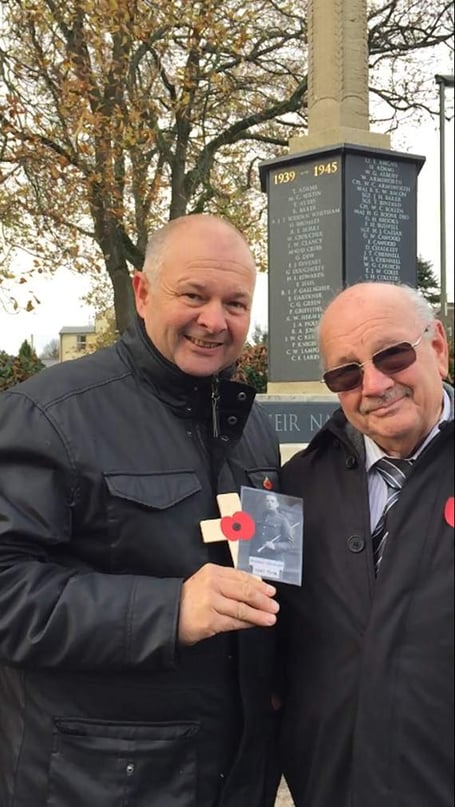
A YOUNG man from Hale killed on the Western Front just months before the end of the First World War has been commemorated by his family as part of the village’s Remembrance Sunday service.
Robert Victor Trusler was born in Upper Hale in July 1897 one of seven siblings, and enlisted at Guildford on September 7, 1914, joining the Royal West Surrey/Queens Regiment 7th Service Battalion.
He landed in France for the first time in July 1915 on active service, but was soon wounded in the head and spent a period of time in recovery.
On his return to active service, Robert was transferred to the Royal Scots Lothian Regiment, joining the 11th Battalion in France in January 1918.


His new battalion was involved continuously in action throughout 1918 in both Belgium and France. Serving alongside the 9th Scottish division, they were involved in pushing back the Germans in Flanders, regaining territory lost to the German push the previous April.
South of Meteren on August 18, the battalion attacked the German lines at Hoegenacker, going over the top promptly at 11am.
Following a creeping artillery barrage, many troops over-ran the shells and were killed by friendly fire, and Robert’s family believe he was killed in this barrage as no body was ever found. He was aged just 21.
Although the regiment incurred over 70 dead, the attack was deemed a complete success, taking over 300 German prisoners and over-running the German lines.
Robert Trusler’s name is listed on the Ploegsteert Memorial in Belgium, as well as back home on both the Farnham war memorial in Gostrey Meadow and the Upper Hale memorial. He was also awarded the 1914/15 Star Medal and Victory Medal.
Robert’s eldest brother Charlie also served in the Royal Navy during the First World War, and his youngest brother Herbert with the Hampshire Regiment in the Second World War.
Having unearthed much of the above in recent years, Robert’s great-nephew Paul Kelly attended the Upper Hale remembrance service on Sunday and placed a photo of his ancestor among the wreaths at the village war memorial.
Paul told The Herald: “Although Robert’s story is certainly not unique I think it illustrates the tragedy of the First World War. He joined up as a volunteer in 1914, served all through the war, was wounded and then transferred into a completely alien Scottish regiment.
“Scottish soldiers where a particularly aggressive fighting force and I suspect he got caught up in the bravado and killed running ahead of our creeping artillery barrage. Tragically, on August 18, 1918, so close to the end of the war.”
Comments
This article has no comments yet. Be the first to leave a comment.