
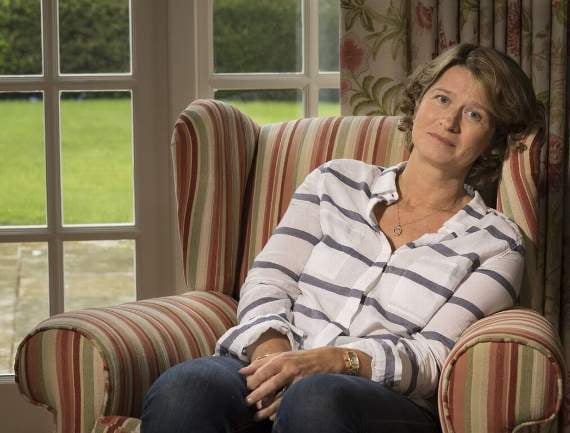
AN Alresford woman who received a stem-cell transplant to cure her acute myeloid leukaemia is linking up with blood cancer charity Anthony Nolan to campaign for better long-term care, as research from the charity reveals that one-in-five stem-cell transplant recipients are not offered any specialist NHS support during their long-term recovery.
Mum-of-two Joanna Calder had a stem-cell transplant from an anonymous donor in 2016. She said: “After my transplant I was desperate to get out of hospital, but once I was home I couldn’t really get off the sofa or out of bed. You just don’t bounce back – it’s very slow progress and it’s probably the worstI felt the whole time since diagnosis.
“I think my lowest emotional time was after the transplant. I questioned why I’d gone through this experience and just couldn’t see an end in those first three to four months. I really wasn’t prepared for the psychological impact of a transplant.
“I was given information about where to look for support when I was in hospital, but I had no energy to engage with it.




“When I got home and we were all trying to get on with life, that’s when I needed psychological support. I wish there had been more psychological support for me and my family – even though staff tried their best, when I really needed the help, it just wasn’t there.”
Despite transplant patients often being known as “patients for life” due to the long-term side-effects of the treatment, many patients are not receiving adequate support for the physical, practical and psychological challenges they experience.
Anthony Nolan is calling on health commissioners to urgently review the care arrangements they have in place for transplant recipients once they leave hospital, to ensure that patients and their families can continue to access vital support and services.
More than 2,000 people a year in the UK need a stem-cell transplant to treat their blood cancer or blood disorder. Currently, national commissioners pay for any treatment needed by patients for the first 100 days after transplant. After this point, responsibility for funding services passes to local commissioners — in England, the patients’ local clinical commissioning group. However, a Freedom of Information request by Anthony Nolan found that, at present, fewer than one-in-10 (9%) clinical commissioning groups have specific arrangements in place. Worryingly, more than a third (36%) of the groups are unaware that the responsibility for patient services after the first 100 days lies with them.
As a result, patients face long delays for services, including access to counsellors, physiotherapists and gynaecologists, with one-in-five patients not offered any specialist support at all.
A survey from Anthony Nolan found that where patients are offered practical support, such as help at home or getting back to work, 97 per cent find it beneficial. However, of those who needed practical support, only 50 per cent were offered it.
Similarly, nearly half (47%) of respondents said that they felt they needed emotional and psychological services such as counselling and group therapy, but of those who said they needed it, only half (54%) actually received it.
This increases the burden on patients and their families, and can negatively affect their mental health, finances, and physical recovery.
Henny Braund, chief executive of Anthony Nolan, said: “It’s vitally important that health commissioners carry out an urgent review into the long-term care that stem-cell transplant recipients need throughout their recovery.
“Many transplant recipients face a long, slow recovery and significant changes to their health and lifestyle. It is unacceptable that many patients have little or no access to specialist support, making adjusting to life post-transplant even more difficult.
“Anthony Nolan is calling on health commissioners to work with the clinical community and make sure that post-transplant care works for every patient, to ensure they get the support they need to make a good recovery.”
The charity is encouraging its supporters to e-mail their MP to ask for their help in bringing this issue to the attention of health commissioners.
For more details, visit anthonynolan.org/whocares.
Comments
This article has no comments yet. Be the first to leave a comment.