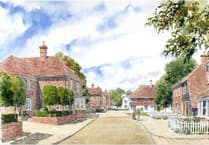
GROUPS supporting the inclusion of the western Weald in the proposed South Downs National Park rallied to give their final message of advocacy as the prolonged inquiry came to a dramatic finale. They now face an anxious wait for the "momentous" outcome as the inspector compiles his report – with a verdict expected by the end of the year, before being handed over to the Government for a final ruling. The inspector at the head of the inquiry heard representatives from Natural England, the Campaign to Protect Rural England (CPRE) and the South Downs Campaign all state their case to preserve the landscape of areas within the western Weald, including Petersfield, Liss, Buriton, Sheet, Steep, Hawkley and Greatham. And author Bill Bryson, who is the CPRE president, added his own written representation. An initial deadline of early April for the closure of the inquiry in Worthing, West Sussex, was pushed back as a wealth of evidence came forward from campaigners. What began on February 12 finally ended last week. A closing statement day of "powerful advocacy" saw the inspector taken through detailed summaries of the reasons why the Wealden landscapes around Petersfield and Liss, with the Rother Valley, its market towns and heaths and commons, should be part of the new South Downs National Park. Christopher Napier, national vice-chairman of the CPRE, speaking for the South Downs Campaign, told the inspector that the position was quite clear – there was no reason why a national park within the South Downs should be confined to chalk areas. Robert Griffiths QC, for Natural England, agreed, as did Peter Towler, the barrister representing Hampshire County Council, who had spoken at the previous session of the inquiry. CPRE member Margaret Paren, who is also vice- chairman of the South Downs Campaign, which co- ordinated all and presented much of the evidence produced for the inquiry by the campaign's members, quoted eloquently from the evidence on the beauty and the "sense of enclosure, mystery and remoteness that characterises the hills" of the western Weald. Referring to the testimony of Professor Robert Tregay and other witnesses, she reminded the inspector that the campaign had proved that Natural England was right to propose that these landscapes should be in the national park. She argued they were some of the most beautiful in England, with a rich variety. South Downs Campaign chairman Robin Crane spoke with a conviction borne of 20 years' campaigning for the South Downs National Park of the steadily increasing groundswell of support for the campaign's position and the opposition to a 'chalk only' park. Other topics he covered included the "gem-like quality" of the heathlands, ancient woodlands, sandstone hills, and the towns and villages that campaigners want to be in it. He added: "The outcome of the inquiry will be momentous. You are considering the long-term future of an extensive area of the finest landscapes in Britain. Your recommendations and the Secretary of State's decision will determine the future of this special and much-loved countryside, not for five or 10 years but as far as one can foresee into the future." Robert Griffiths, in his summing up of Natural England's case, surgically dissected the evidence of the consultant employed by West Sussex and Chichester who had sought to prove that only the chalk downs had something she called 'national park quality'. CPRE president Bill Bryson, popular with millions of readers for his humorous observations of England and the English, most notably the countryside, has written to the inspector to explain why the western Weald should be part of the park. He said: "As someone who has travelled the world, who has visited all parts of this island, frankly I cannot understand where such ideas came from. Believe me, this is a jewel; please conserve it, preserve it and confer on it the status it deserves, that of a nationally important landscape for all to enjoy as a national park."