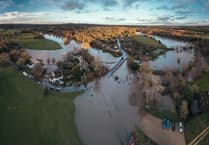
THERE will be no decision on the East Street planning application next week, with developers confronting the possibility that design changes may be forced on them to overcome flood risk fears. The planning process was delayed last month for a fortnight, after complaints that Waverley Council was breaching regulations in not allowing the public sufficient time to view a technical briefing report. Then last week the council announced that it had extended the consultation period by at least 21 days, to enable the public to view seven appendices to a technical background document which had been missing from the public files on the planning application. The 21-day delay will be of no significance, however, if developers Crest Nicholson Sainsbury's (CNS) are being sent back to the drawing board by the Environment Agency, which wants higher flood levels used for the River Wey. Speaking at a technical briefing meeting in public last Wednesday, architects for the developers said they would have to make engineering and design changes to the plans because of information received from the Environment Agency just two days earlier. East Street campaigners, however, appeared to be one step ahead on the issue. For earlier in the meeting, during the public0speaking session, the Farnham Society's Stephen Cochrane had highlighted "fundamental problems", asserting the scheme could not be approved without a major redesign. He accused CNS of using ground water data based on July 2006 borehole measurements, taken following years of drought and hosepipe bans. And he said CNS was working to an assumption that the river would reach no more than 63.5 metres above sea level, yet for the Riverside planning application downstream, a measurement of 63.71 metres above sea level had been accepted by Crest Nicholson, Waverley Council and the Environment Agency, even though the river was actually half a metre lower there. "It is impossible, gravity doesn't work this way," stressed Mr Cochrane. "If you build in the flood zone, are you prepared for flooding seen in similar situations around the country and can you guarantee that these dwellings will be insurable against flood risk?" he asked. Christopher Tennant, planning director for the scheme's architects, Scott Brownrigg, said that two days before the meeting they received an Environment Agency assessment setting the flood level at 64 metres within the site area. "We've been in discussion with the Environment Agency for many, many years, and in 2006 the EA concluded that the flood level for this development should be set at 63.5 metres," said Mr Tennant. He told the meeting: "I'd like to make a statement that we are working with the EA and Thames Water to fully address their concerns in relation to flooding, in relation to the safe access and egress of residents from the development, and look at the potential drainage and flooding issues that have been raised by the EA. "We'll need to make some amendments to the scheme, particularly in relation to the location of the balancing pond, and particularly in relation to the level of flood compensation that would be provided from within the site." Mr Tennant said that when the appropriate measures have been agreed with the EA there would be a 21-day period of public consultation on the changes. Waverley Council leader and East Street portfolio holder Richard Gates said on Monday that until further discussions between the developer and the Environment Agency were over, it would not be known whether a material redesign - or any changes at all - would be necessary. He described himself as "bemused" by the Environment Agency "changing the goalposts". "Until about 10 days ago the EA had indicated that all the calculations did not indicate that there would be any significant changes necessary," said Mr Gates, pointing out that the agency had raised no objection to the earlier, larger, application for the site. "What has caused the EA to change its calculations? Scott Brownrigg have clearly got to understand that." Campaigners are fighting a vigorous battle against the East Street scheme, employing legal advice and an independent planning consultant, but Mr Gates said he was unperturbed by this. "We are absolutely clear that everything we do is going to be entirely in accordance with the processes we are meant to follow," he said, explaining that this was why next week's planning meeting had been postponed to allow consultation on the missing appendices. Although disappointed by the delay, he believed it was justified for such a large and important development. "We are determined to put things in front of members that are right and that don't bring challenges afterwards."