
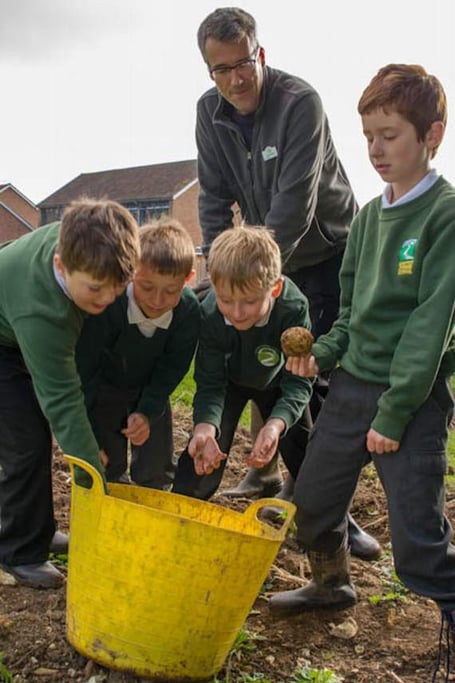
IT’S well known in Alton that the children of Anstey Junior School love their vegetable gardening.
Most school days, the young members of the Gardening Club convene and children have the opportunity to learn all sorts of horticultural skills, from sowing and planting to harvesting and eating the produce.
This year has been a bumper one, particularly for the potatoes grown by the children in a corner of the school playing field. A range of traditional varieties yielded around 250 kilos of potatoes which were shared out among pupils and the community.
Now plans are afoot to create a sizeable school allotment and to seek sponsorship for a school polytunnel. Together with the existing potager, these facilities will offer all pupils a broad horticultural experience.




And these earthly endeavours are about to get a huge boost from a surprising source – outer space, to be precise! Anstey Junior School has just been selected to participate in the Royal Horticultural Society’s rocket science experiment.
This national experiment aims to get schoolchildren from all over the UK thinking about the challenges of growing food in space. In September, two kilos of rocket seeds were flown to the International Space Station on a Soyuz 44S rocket. The seeds are presently held in microgravity under the watchful eye of British astronaut Tim Peake.
The seeds will return to earth next April and Anstey Junior School will be one of 10,000 schools to receive 100 seeds from space.
These seeds will be grown alongside seeds that haven’t been to space to detect any difference in growth. In an interesting twist, no-one at the school will know which seed is which.
And the type of vegetable seed in question? Rocket, of course!
Archie, Thomas, Finlay and Ted are pictured with site manager Max Akroyd digging up potatoes
Comments
This article has no comments yet. Be the first to leave a comment.