
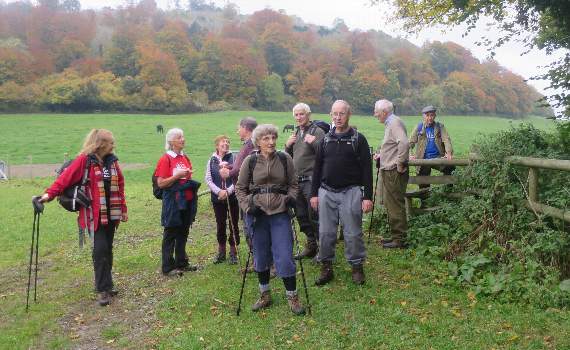
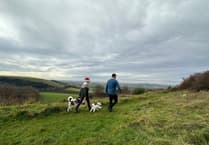
A GROUP of Care Africa Network supporters met for the group’s ninth annual ‘autumnal colours’ walk through Selborne Hangers.
Starting from the Selborne Arms, under the Beech Hangers, they walked the chalk pits of Noar Hill, past Goleigh Manor, and across Selborne Common before descending the Zig-Zag cut by Gilbert White and his brother John 250 years ago.
It is the route trodden annually by Care Africa Network supporters since 2008, providing a magnificent vista over the surrounding countryside and the autumn colours that were much loved by Gilbert White when he spent his childhood and eventually became vicar of St Mary’s in Selborne during the 18th Century.
This annual sponsored walk has become the fulcrum of the fundraising activities of the charity and this year raised £600 on the day, with further donations anticipated that should bring the total closer to £1,000.
Care Africa Network is a small, Hampshire-based charity dedicated to the support and development of the African extended family for the care of orphaned and vulnerable children who are often the casualties of Aids or conflict.
Founder Francesca Simms said: “Care Africa Network is a hands-on charity that has assembled, through research in Kenya, Lesotho, Uganda and Swaziland, a potpourri of ideas that can help communities provide support for these disadvantaged children by building on the established African culture of community care of children.
“The charity seeks to promulgate this knowledge to those who can influence the outcome of specific situations at a grass-roots level. It does this by a direct engagement with government social workers, field workers in NGOs, and more recently by including its presentations in university undergraduate courses for future social and care workers.”
The principal of the charity also holds a licence to teach a method for the treatment of post-traumatic stress disorder in children, which can often be a symptom of the victims of Aids and its consequences. Instructing others in the use of this amazingly effective therapy complements the practical aspects of the other training.
The charity fulfils its purpose by providing lectures and workshop training. It backs these sessions with publications and consultations which are made freely available to all participants. On occasion it has provided seed-corn funding for income generating projects that enables self-sufficiency in families caring for orphaned children.
In January and February, according to Ms Simms, it provided seven two-day training courses in Lesotho and Swaziland.
“In Lesotho, the training was for government social workers but the courses were also given to the fourth year undergraduate course for social workers at the National University of Lesotho,” she said.
“In Swaziland, training workshops were provided for a mixed group of nurses, NGO staff and volunteers, together with members of a partner organisation that runs peer-group empowerment clubs for young people.
“In all, more than 120 people participated in the training that was offered. All have opted to become Care Africa Network extension workers and are committed to promoting and developing good family-based community care for orphans and vulnerable children. They plan to develop a number of projects arising from the ideas presented at the courses. Some of the projects planned during the 2015 courses are already under way.”
Care Africa Network always welcomes volunteers and particularly those with accountancy, book-keeping and organisational skills, and those interested in assisting in fundraising events.
Ms Simms added: “Everyone who works for Care Africa Network donates their expertise and time free of charge, and often their travel expenses too. Consequently, the funds the charity raises really do go where they are needed to improve the lives of orphaned and vulnerable children in Africa.”
For more details about the work of Care Africa Network, or to make a donation, visit careafricanetwork.org.uk.
Comments
This article has no comments yet. Be the first to leave a comment.