
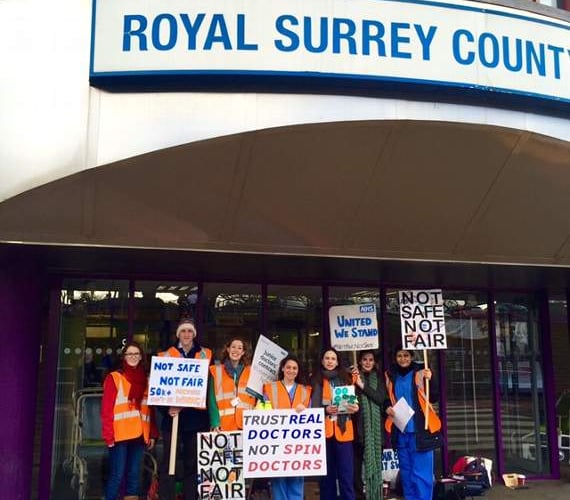
JUNIOR doctors at The Royal Surrey County Hospital joined tens of thousands of their colleagues on Tuesday taking industrial action over what xHealth Secretary Jeremy Hunt claimed was an “unnecessary” contract dispute.
Striking doctors joined picket line manned all day by the hospital’s main entrance, taking it in turns to protest every 45 minutes in groups of six. Emergency care was unaffected by the industrial action.
The Royal Surrey had promised beforehand to put a “robust contingency plan” in place. In a statement released on Wednesday, it said the industrial action had caused “minimal disruption” to patients and services and it had maintained as many appointments as possible.
Chief executive Peter Dunt said: “A great team effort ensured there was minimal disruption to patients, with just 151 of 1,600 outpatients appointments postponed and 15 operations affected.



“For those patients who were affected, I would like to assure them we will reschedule their appointments as soon as possible. We continue to thank them for their understanding.”
Tuesday’s 8am walk-out went ahead after negotiations were paused last week on a new contract that junior doctors fear lacks contractual safeguards on safe working and proper recognition for those working unsocial hours.
Both sides in the conciliation talks between the British Medical Association (BMA), NHS Employers and the Department of Health – organised by the Government arbitration service ACAS – agreed the discussions while “constructive”, were not enough to call off this week’s planned action by the BMA.
The talks were due to resume yesterday (Thursday). If they do not succeed, the association is planning strike action lasting from 8am on Tuesday, January 26, until 8am on Thursday, January 28.
Only emergency cover will be provided, and a full withdrawal of labour from 8am-5pm on Wednesday, February 10.
Royal Surrey junior doctor Ravin Mistry, a fellow in high risk anaesthesia, told The Herald it had been an “incredibly hard decision” to take strike action, but junior doctors had reached the “tipping point” and had “no choice”.
He and fellow colleagues on the picket line were encouraged by the positive comments they received from members of the public.
“We stood at the main entrance in a very busy area and we had overwhelming support from members of the public,” he said.
“They were encouraging us to continue to stand up to the Government.
“It was incredibly hard to do this. I’ve been qualified as a junior doctor for 12 years. We work hard seven days a week, it’s part of the job. The tipping point came with a new contract that threatened to take away patient safety.
“It’s already a strained system. We have been tipped over the edge and have to say enough is enough. There have been so many misunderstandings about the contract. We are not asking for more money and it’s not about working nights and weekends – we do that anyway.
“The Royal Surrey is an incredibly busy hospital and staff across the board go above and beyond what’s required to make sure patients are safe. I agree absolutely there is room for improvement, but changing the contract for junior doctors who work 24/7 anyway is not the answer.
“It’s a question of resources. The NHS is chronically underfunded.
“The NHS needs more nurses, physios, porters and frontline staff across the board not more junior doctors. There’s a lack of focus on what’s required.”
Mr Hunt said: “As the MP for South West Surrey, I know how lucky we are to have one of the best hospitals in the country – the Royal Surrey County Hospital. I’m proud to have fought to save the Royal Surrey from closure, a decision that has been vindicated by the CQC’s most recent inspection rating it as ‘good’ overall.
“In light of this week’s strike action, I want to thank staff at our local hospitals who worked so hard to keep patients safe.
“Nearly 40 per cent of junior doctors across the country arrived for work, and our consultants, nursing staff and wider hospital staff all worked incredibly hard to make sure that patients didn’t come to harm.
“We want the NHS to be the safest healthcare system in the world. We know that is what doctors want too. So it was extremely disappointing that the BMA chose to reinstate industrial action.
“In the end, this is an unnecessary dispute. There has been some disagreement about some of the pay issues, but I think there is agreement on the vast majority of the changes that we want to make in the medical profession.
“We all – doctors and politicians – want to promise every NHS patient the same high quality of care every day of the week.
“At the moment, mortality rates in some clinical areas are higher if you are admitted at the weekend.
“That cannot be acceptable. The right thing to do is to sit around the table and talk to the Government about how we deliver a truly seven-day NHS. This was a commitment in this Government’s manifesto and endorsed by the British people. I have now asked ACAS to reconvene talks in the hope the BMA will return to sensible negotiations.
“In the meantime, I thank our dedicated hospital staff for their tireless contribution this week.”
Comments
This article has no comments yet. Be the first to leave a comment.