
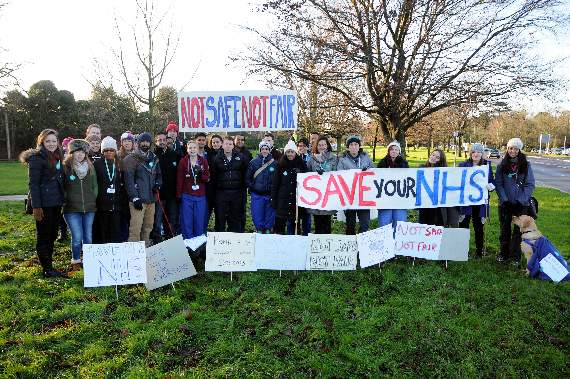
DOCTORS from the two major hospitals serving Farnham joined the picket lines on Tuesday as the first junior doctors strike in 40 years took place amid wind, rain and freezing temperatures.
Around 40 junior doctors and supporters held a demonstration outside Frimley Park Hospital from 8am until noon before bringing their placards to Lion and Lamb Yard, Farnham to speak to the Health Secretary, MP Jeremy Hunt’s constituents in a Meet the Doctors event.
The 24-hour walkout, the first since the 1970s, was called by union the British Medical Council in a dispute over a new junior doctors’ contract which the Government says is necessary to reduce weekend mortality rates but the BMA believes would stretch the NHS to breaking point.
Emergency care was unaffected by the industrial action. However, a spokesman for Frimley Park confirmed 10 elective operations or procedures and around 220 outpatient appointments had to be rescheduled while the Royal Surrey County Hospital saw 15 operations affected and 151 outpatients appointments postponed.



Among those to strike was Frimley Park A&E doctor Sammy Batt-Rawden, who joined the picket line after 14 days working without rest, including a 15-hour shift the night before the strike began.
She told The Herald: “Everyone has been really supportive and even the hospital’s chief executive, Sir Andrew Morris, has come out this morning to lend us his support.
“People have been honking their car horns and every single member of the public walking past has given us a pat on the back. I even had one lady give me her gloves because she said I needed them more than her, which was very sweet.
“I’m devastated that it’s come to this to be honest. I never thought when I was training that I would end up on a picket line as a doctor outside of a hospital. But unfortunately we’ve been forced into a corner by Jeremy Hunt and there’s a real collective sense of feeling and unity amongst us because we know that if these changes go ahead that the NHS as we know it won’t be sustainable.
“I hope we’ve managed to get our message across to the public that this is about saving the NHS and particularly about patient safety. Yes, pay is part of it, but we are incredibly worried about the state of the NHS and that’s what we’re fighting for.
“The Department of Health wants to make evenings and weekends normal working hours and introduce a seven-day service when they’re not able to fund or resource a five-day service. Doctors feel that would be very unsafe.”
Junior doctors initially voted in favour of a walkout at the beginning of December last year, but this was cancelled at the 11th hour after the BMA and Department for Health agreed to resume talks via conciliation service ACAS.
The negotiations broke down again last week, however, leading the BMA to launch a new wave of industrial action, starting with Tuesday’s 24-hour withdrawal of routine care and followed by a further 48-hour walkout on January 26 and a total withdrawal of labour, including emergency care, on February 10.
Reports of positive talks between the BMA and the Government in the wake of Tuesday’s strike action suggests this may not be necessary.
Dr Batt-Rawden continued: “I really hope the public will listen and get behind us as they seem to have done, and Jeremy Hunt will finally listen. Doctors haven’t been on strike for 40 years, this is a huge deal. 98 per cent of doctors voted for this action, that’s 54,000 doctors across the country who are whistleblowing and saying this is not safe, you have to listen.
“Morale is a huge thing in this, and everyone’s at rock bottom. We’re all exhausted and just burnt out, and I think making us work more evenings, more weekends and taking away our rest time is just going to be disastrous and people are going to leave the NHS in droves.
“The Government needs to recognise that it’s important for doctors to rest. Places like Australia have gone to a four-day working week, recognising that doctors are just burning out and leaving.
“Nobody should be treated by a doctor who’s worked 14 days straight. It’s just crazy and rather than pushing for us to work more hours for less, the Government needs to recognise the route of the problem and stop pushing us so hard.
“This isn’t about a week of strikes or a day of strikes - This is about the NHS in five years, 10 years, 20 years. We’re all really sorry that patients are having their appointments rearranged and their operations cancelled. That’s awful, but at the end of the day we’re trying to save the NHS.”
Another Frimley Park junior doctor, trainee anaesthetist Kayur Patel, was among those greeting shoppers in Lion and Lamb Yard on Tuesday afternoon, joined by activists from National Health Action including 2015 parliamentary candidate Dr Louise Irvine.
He said: “We want to give the public a chance to ask us questions and try and gain some support, to understand what their frustrations may be and to help them understand why we are doing this - to protect the future of the NHS.
“We’ve had a lot of support from people of all ages, which has been very positive. It is a very confusing issue, but I think members of the public do understand that staffing our hospitals in the future is going to be a real issue and realise the NHS is on the brink of something disastrous.”
Comments
This article has no comments yet. Be the first to leave a comment.