
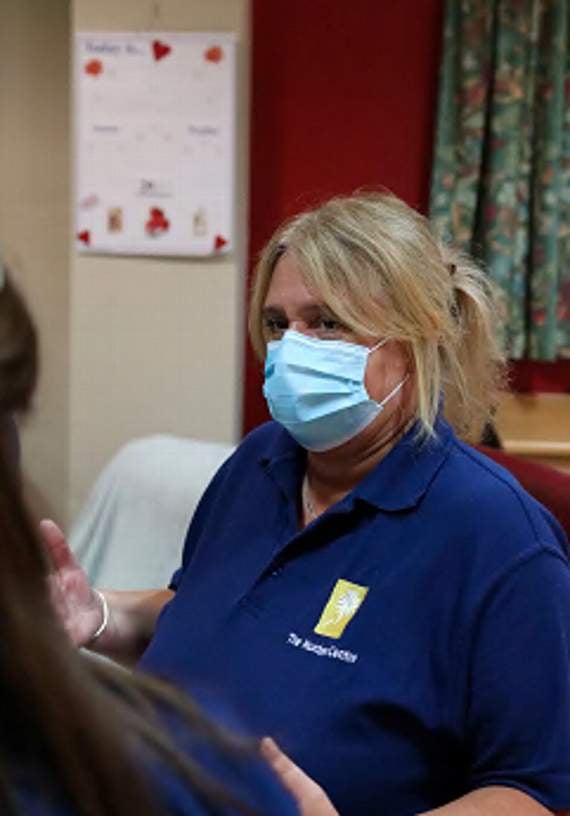
The trustees would like to thank the team for their continued hard work in ensuring that The Hunter Centre is kept clean and safe during these difficult times.
Two weeks has now passed since The Hunter Centre reopened its doors after being closed for four months.
Operations manager Elaine Clement said of the past two weeks: “All our clients and their carers were happy to see us again – they haven’t seemed fazed by the girls wearing PPE and all have been enjoying their time with us.



“One carer commented she ‘hadn’t seen her husband so happy in a long time as he was after his first day back’, while another told us ‘We are so grateful to the wonderful staff at The Hunter Centre for taking such great care of our Mum – she has really enjoyed being back at the day centre and seems livelier and more stimulated than she has been since lockdown. It is lovely that she is back with her friends again!’
“Clients at the centre have been taking part in memory games like Scrabble, are able to access the beautifully-kept gardens to watch the birds, and make use of the memory boxes the centre has on offer, designed to spark conversation and recall memories.
“Since we reopened our doors and welcomed our clients back, we have been delighted to see familiar faces and be able to provide relief for our carers who have been so isolated for the past six months.
“The most important thing to the centre is the safety of our clients, carers and staff, but now we are open we are able to allow our clients to interact with one another.
“It is known that socialisation is key for slowing the advancement of the illness, so being at the centre helps clients to feel connected, to spark the senses and to offer human interaction with other people, which has been so missed during the Covid-19 lockdown.”
Government statistics show that around 60 per cent of the UK’s dementia patients live in their own homes, and therefore have become extremely isolated during the past six months.
Human interaction is vitally important to a person living with dementia; it can enhance and maintain focus, strengthen the connection to time and place, improve brain health and help gain a greater sense of belonging.
The more time the brain spends socially engaged, the easier individuals will find the transition between memory and reality, reducing the sense of isolation. Socialising is unlikely to halt the progression of the illness, but has more impact on a person’s quality of life.
Social contact is a key ingredient, and the need for this hasn’t reduced, despite Covid-19. A lot of centres and groups have been unable to reopen, so the work of The Hunter Centre is key to the communities in Surrey, Hampshire and West Sussex.
For further information contact operations manager Elaine Clement on 01428 654710, email [email protected] or see the website www.thehuntercentre.co.uk
Comments
This article has no comments yet. Be the first to leave a comment.