
Water voles – as immortalised as Ratty in The Wind in the Willows – were once a familiar sight alongside Britain's rivers, streams and wetlands.
Today they are sadly the country’s fastest-declining mammal after decades of habitat loss, pollution, agricultural pressures and predation by the invasive American mink.
National estimates now stand at between 58,000 and 186,000 individuals, making every remaining stronghold for the species increasingly important.
But there are growing signs the species is beginning to fight back in Surrey and Hampshire thanks to years of conservation work.
Last month, wildilfe experts celebrated the return of water voles to the River Wey for the first time in more than 20 years.
About 300 were released into the river between Froyle and Farnham, having been bred in a large pen near the Devon and Cornwall border.
Now there is more encouraging news in Hampshire.
A water vole survey conducted by Hampshire & Isle of Wight Wildlife Trust has revealed that the species is thriving along a stretch of the River Meon at St Clair's Meadow Nature Reserve.
The survey, carried out by Hampshire & Isle of Wight Wildlife Trust with the River Meon Conservation Volunteers, recorded extensive evidence of water vole activity including feeding stations and remains, burrow entrances and latrines.
The findings suggest a healthy and active population during the breeding season and are thought to be among the strongest recorded at the reserve using a new monitoring method.




Andy Reeves, reserves officer (Central Rivers & Downs) at the Trust, said: "What makes a survey like this so exciting is seeing just how much evidence water voles leave as they go about their daily lives."
Water voles can be difficult to spot, so surveyors look for the clues they leave behind rather than relying on direct sightings.
They found feeding stations with neatly cut stems clipped at the distinctive 45-degree angle that water voles are known for, plus active burrows and characteristic latrines along the riverbank.
"Some of their green, tic-tac-shaped droppings have been flattened into what we call 'trampled latrines', where water voles stamp them down to scent mark their territory during the breeding season," said Mr Reeves.
"Finding so many of these signs shows that the population is feeding, breeding and thriving here at St Clair's Meadow Nature Reserve."
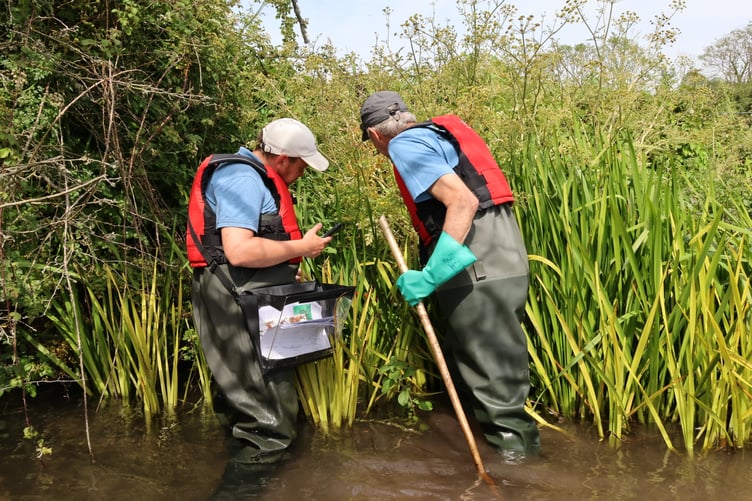
Rather than surveying solely from the riverbank, trained staff and volunteers now search the vegetation for field signs from within the river itself, following water safety procedures and wearing appropriate clothing and safety equipment.
This has proved highly successful, enabling a much more detailed assessment of water vole activity and significantly increasing the number of sightings.
The results reflect a wider encouraging picture emerging along the River Meon. Survey data collected by the South Downs National Park Authority (SDNPA) and SDNPA volunteers in 2025 recorded water voles at 32 of the 35 sites surveyed, with evidence of breeding at 22 locations.
The SDNPA results contribute to emerging evidence of a slight recovery in water vole populations at a national level. However, water voles remain the UK's fastest-declining mammal and long-term conservation work remains essential.
A key reason for the species' recovery on the River Meon has been the Meon Valley Water Vole Project. Launched in 2013 by the SDNPA and the Meon Valley Partnership, with support from Hampshire & Isle of Wight Wildlife Trust, the project has seen more than 2,800 water voles released into the river system. It is the UK's largest water vole reintroduction within a river valley and the only project of its kind to have taken place in Hampshire.
Together with the recent reintroduction on the River Wey at Farnham, the projects represent two of the biggest recent milestones in water vole conservation in southern England.
While the River Meon has benefited from more than a decade of reintroductions and habitat restoration, the Farnham project marks the beginning of what conservationists hope will be a similar recovery on the Wey.
The River Meon is one of the most important strongholds for water voles in Hampshire. Its clear chalk stream waters, well-vegetated banks and good habitat conditions provide an ideal home for the species. In addition to the reintroduction programme, years of partnership work to improve river habitats, reduce predation pressures and support wildlife have helped create the conditions for populations to recover and thrive.
Mr Reeves added: "Water voles may be small, but they play a surprisingly important role in a healthy river ecosystem. Their feeding and burrowing behaviour helps shape riverbank habitats, benefiting a range of other species and helping maintain the rich wildlife that helps make chalk streams like the Meon so special."
Monitoring work is made possible through a long-standing partnership involving Hampshire & Isle of Wight Wildlife Trust, the South Downs National Park Authority and dedicated volunteers. The River Meon is believed to be one of the most intensively surveyed rivers for water voles in the country, providing valuable data on the species' status and recovery while contributing to national monitoring efforts.
Mr Reeves said: "Monitoring is absolutely essential. Conservation doesn't stop once a species has been reintroduced. We need to keep tracking populations to make sure they remain healthy and to identify any threats early.
"I'd like to thank the River Meon Conservation Volunteers, whose efforts collecting data feed into national monitoring programmes and help us understand how water voles are faring not just here on the River Meon, but across the country."
The survey is thought to be one of the most successful at the site to date using a new monitoring method, which records detailed field signs directly into a national monitoring programme. The National Water Vole Monitoring Programme helps conservationists build a better understanding of how the species is faring nationally.
Hampshire & Isle of Wight Wildlife Trust also plays a leading role in water vole recovery nationally. The Trust is co-author of the National Water Vole Database and Mapping Project, which collates records from across the UK and helps guide conservation action to the areas where it is needed most.
Although the River Meon and River Wey projects are at different stages, together they demonstrate that water voles can recover when rivers are restored, invasive predators are controlled and long-term monitoring is maintained. Conservationists hope they represent the beginning of a wider recovery for one of Britain's most threatened native mammals.
Visitors can also help protect water voles and other wildlife by staying on paths and keeping dogs on leads when near riverbanks to minimise disturbance to wildlife and sensitive habitats.
The success at St Clair's Meadow reflects Hampshire & Isle of Wight Wildlife Trust's aim to bring more land into nature recovery. Alongside managing existing wildlife-rich sites, the Trust is restoring habitat at nearby Court House Meadows. This newly acquired land, through which the River Meon flows, is creating more space for nature and supporting the long-term recovery of water voles and other species across the wider landscape.
Readers can also support the recovery of water voles and other wildlife by becoming members of Hampshire & Isle of Wight Wildlife Trust.
Membership helps fund habitat restoration, species monitoring and conservation work across Hampshire and the Isle of Wight, including projects along the River Meon.
Comments
We've recently changed our login process. If you have an account for commenting, you will need to re-register on the login window.
This article has no comments yet. Be the first to leave a comment.