
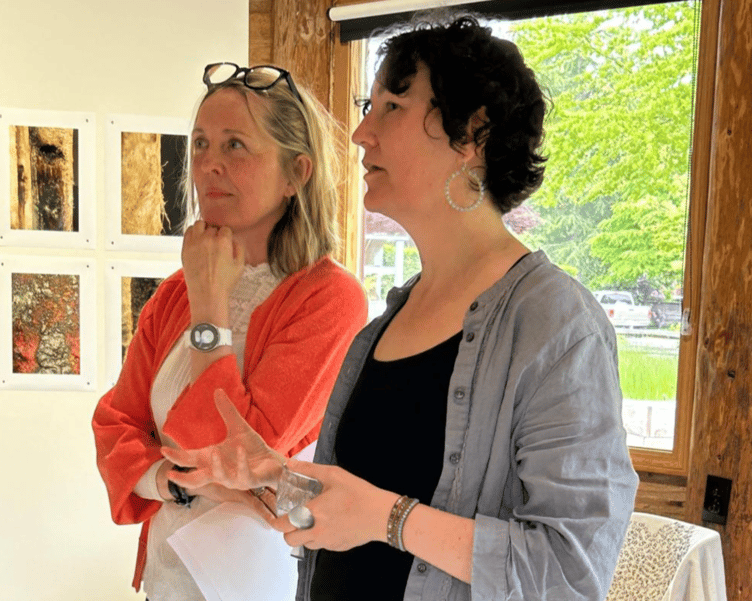
A Farnham woman who was taken from her mother as a newborn under Britain's historic forced adoption system has welcomed the Prime Minister's apology to survivors.
Samantha, 59, says it is a step towards recognising the lifelong trauma endured by thousands of mothers and their now-adult children.
Samantha was among those in the public gallery at the House of Commons earlier this month when Sir Keir Starmer, in one of his final acts before leaving office, apologised on behalf of the British state to victims of historic forced adoption practices.
"The apology was very welcome. I was able to be in Westminster to hear it live. There were a lot of tears that day," said Samantha.
"It was very moving. Sir Keir did a really good job at delivering a sincere apology and managing the follow-on comments from the House."
Born at Mount Alvernia Hospital in Guildford, Samantha said her Canadian mother came to stay with family friends in Godalming after discovering she was pregnant.
"I was born at Mount Alvernia Hospital in Guildford. My mother is Canadian and, because my grandparents were on sabbatical in Europe, they arranged for her to come and stay with family friends in Godalming.
"Unfortunately, as well as providing childcare for their children, she was also used as an example of how not to behave.
"She had been living in Canada independently when she found out she was pregnant. My father didn't want to be a father, so she was left with little option but to contact her parents.
"As I was growing inside her, she started to bond with me and crocheted items for me.

"When I was born, I was taken from her by the nuns and she wasn't allowed to see me. I was not well - I had a laryngeal stridor - and was essentially on my own for about 10 days. One of the kinder nuns did allow her to take me to the chapel to pray with me, but that was all the contact I believe we had in those first few days."
She spent about four months in foster care before being adopted. Her mother later tried unsuccessfully to stop the adoption.
"By the time the letter arrived, I'd already been given to another couple," said Samantha.
"When my grandfather found out that I had been 'placed', he refused to let her come back and get me."
"It was a combination of influences from the Church - my grandparents were devout Christians; the Franciscan nuns at the hospital; the pious attitudes of the time, which dictated I would be better off with an already married couple; my father's initial refusal to step up and my grandfather's final intervention."
"The process wasn't a good one for me. I lost my mother, my family, and nationality the day I was born, and I never really felt like I belonged or was 'right' where I was put.
"My name had been changed. I didn't know who I was until I was 18. I didn't even know I was Canadian until then either."
Her mother eventually traced her when she was 30.
"My mother came back to find me when I was 30. It was a difficult reconnection for various reasons and I ended up having to comfort both my adoptive mother and my mother. Neither were able to comfort me."
"I don't sound Canadian because I grew up here, but I was able to have my Canadian citizenship restored a few years ago, so then took a sabbatical to spend a year with my 'mom'."
Over the past decade she has campaigned for official recognition of the harm caused by historic forced adoption.
"After survivors gave evidence at the JCHR hearing, the Adult Adoptee Movement really began to come together. Founded in 2022, it became the catalyst for bringing us adult adoptees in the UK together."
"Initially it was mainly about the mothers but the two groups joined forces around 2022 and testified together at the Education Select Committee early in 2026. I am so glad that happened!
"The mothers lost their babies and we (now adult) children lost our entire families."
"The popular narrative is that adoption is always a wonderful thing, when in reality an adoption order strips you of your legal identity and places you with strangers who you're expected to call your parents. It can be a lot to process as an adult.
"People have said to me, 'Oh you're one of the lucky ones.' It's much more complicated than that."
"The next step is to see what specific commitments are put into place in the way of reparations. There is talk of easier access to records and better access to appropriate therapeutic resources via the NHS as well as peer support and documenting our lived experiences.
"For me, it's also about changing the narrative around adoption. I know there are those who would say they had a good experience, but I know too many people who would not, and who have been harmed by the practice."
Samantha moved to Farnham in the 1990s to study 3D Design in metals at what was then West Surrey College of Art and Design. She later completed a master's degree at West Dean College in Sussex, creating artwork exploring her relationship with her mother.
Last year, her work came full circle when she exhibited in a gallery in Sechelt, British Columbia, where her mother retired.
The apology followed years of campaigning by birth mothers, adopted adults and their families, as well as parliamentary inquiries examining the state's role in historic forced adoption practices.
An estimated 185,000 babies were taken from unmarried mothers in England and Wales during the 1950s, 1960s and 1970s. Many women were pressured into giving up their children because of the social stigma surrounding unmarried pregnancy, with practices involving local authorities, religious organisations and parts of what is now the NHS.
Alongside the apology, the Government announced a £4 million support package over the next three years to improve access to adoption records, strengthen family reunion services and establish support groups for birth mothers and adopted adults.
At Samantha's request, her surname has not been published.
Comments
We've recently changed our login process. If you have an account for commenting, you will need to re-register on the login window.
This article has no comments yet. Be the first to leave a comment.