
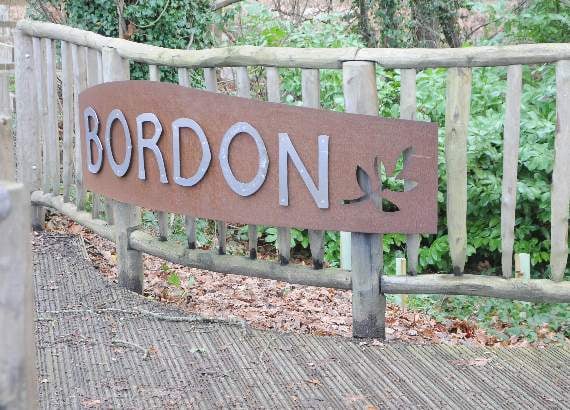
QUESTION marks hang over the Bordon Inclosure following a boundary error, which has led to East Hampshire District Council being ordered to remove new fencing and associated works.
The dispute over the land arose as the northern section of the Bordon Inclosure, which is classified as a SANG (Suitable Alternative Natural Greenspace), encroaches on common land - Broxhead Common.
This means that the new fencing which runs along Lindford Road, as well as gates and other works, was built without planning permission and contravenes common-land policy.
Whitehill Town Council chairman David Cooper said, at a Monday meeting, that the situation was “very, very sad” and had left many local people scratching their heads. “So many people feel so strongly about this, it’s incredible,” he said. He told the Bordon Herald that “vast sums of money were spent” on the fencing and other works, describing the mistake as “dreadful”.


At the council meeting, councillors questioned where the council stood.
Chris Mitchell said that if the fence was taken down, as it legally must be, then “the SANG is breached”.
“SANG means it is an enclosure, in other words its fenced all the way around,” he added.
The issue is of particular concern to the town council because it manages the Bordon Inclosure, having last year acquired an 80-year lease from landowner - the Defence Infrastructure Organisation (the property arm of the Ministry of Defence).
“We took this on as a fait accompli,” Mr Mitchell said. “But now this has cropped up. As we manage it, we ought to have an input. We don’t even have a voice.”
Mr Cooper agreed and said he was “amazed” by the ruling. “I was rather sad, nobody has defended this,” he added. “Nobody seems to be fighting at all.”
Adam Carew said: “Obviously we’re very disappointed.”
He remained “puzzled as to what the SANG status is”. The whole point of a SANG, he said, is to “allow your dog off the lead”. “If you are unable to do that then I can’t see how it can remain a SANG,” he said.
He called for formal clarity from Natural England.
In terms of solutions, it was suggested that the fencing could simply be moved back to the edge of the common-land boundary.
But acting town clerk Andrea Mann explained that the line “goes right the way through Bordon Inclosure”.
“So you could, but it’d almost be like cutting the Bordon Inclosure in half,” she added.
Alan Beckett, an inspector appointed by the Secretary of State for the Environment, Food and Rural Affairs, has ordered East Hampshire District Council to remove the new fencing. But he did give permission for some aspects of the project. Consent was given for footpath improvements, a bench, an information board, five way-
markers (timber bollard signs), and a deck bridge.
But consent was not granted for the fence alongside Lindford Road or the fence between Lindford Road and Lindford Farm.
Neither was consentgranted for the pedestrian, horse or field gates specified in the application. Permission was also denied for the natural play area and three interpretation boards.
Although it remains unclear whose fault it is, a district council spokesman admitted that it was, at some level, “an error” to erect the fencing and works without permission. The fence will be “reused elsewhere” in the site “outside the common land area, but within Bordon Inclosure”, he said.
Following the departure of the Army in 2015, the site was transformed into a SANG as part of legal requirements associated with the Quebec Park and Louisburg housing developments.
The day-to-day management of the 60-acre site is overseen by the Deadwater Valley Trust.
The Government inspector was brought in following representations from the Broxhead Commoners Association, Natural England and others.
The objectors claimed that the status of this part of Broxhead Common, as registered common land, was “incompatible with its inclusion in the SANG”.
As public access for “informal recreation on foot to Broxhead Common” is required under the Countryside and Rights of Way Act 2000, the inspector said it was “surprising that this part of the common had been incorporated into the SANG”.
A Natural England spokesman said that it was working with the district council to find solutions to the boundary issue and Natural England expected that “the site will remain a SANG”.
Whether fencing is necessary around a SANG is taken on a “case-by-case basis”, she said.
Comments
This article has no comments yet. Be the first to leave a comment.