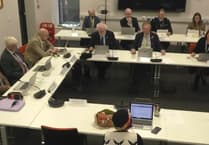
THE founder of the Isitfair campaign, Headley resident Christine Melsom, led a delegation of supporters from across the country on a visit to Westminster, last month, where they put their case for the abolition of council tax to Conservative Party members of parliament. The delegation was received by Caroline Spelman, shadow Secretary of State for local and devolved government affairs, Eric Pickles, shadow Secretary of State for local government, and Philip Hammond, shadow minister for local and devolved government affairs. According to an Isitfair report on the meeting, it started with a challenge from Mrs Melsom to the MPs to agree that council tax in its present form was "unaffordable and unsustainable" and should be abolished. During the debate that followed, Caroline Spelman said the Conservative Party was considering a number of proposals for the reform of council tax, but was unwilling to divulge them at present lest the Labour Party hijacked the ideas as their own. She told the Isitfair delegation she had considered postponing the meeting until she could provide full details of the proposals, but had decided that the meeting would be useful. A more informative meeting would follow. Alton-based Isitfair supporter Colin Aiken outlined the Isitfair proposal, which is to abolish council tax and fund local authorities via general taxation based on an ability to pay. Philip Hammond MP told the delegation that, in his opinion, income should not be the only measure of ability to pay. He cited the problem of people living in multi-million pound mansions, with matching incomes, who manage to evade income tax by employing clever accountants. While council tax is charged on property, such people cannot avoid it, he said. Local Isitfair member David Green commented that it appeared the Conservatives were prepared to penalise the huge majority of ordinary citizens in order to catch a few overseas residents. It was, however, agreed that there would always be some people who managed to evade their tax obligations. Philip Hammond further pointed out that council tax does have two key benefits: it is easy to predict how much revenue it would generate and it is relatively easy to collect. Caroline Spelman agreed with Isitfair that the Labour government had made council tax into the "ultimate stealth tax". However, the Conservatives still believed that a property- based tax was the only way to ensure local democracy and accountability, since "you can't hide a house", she said. Isitfair drew attention to the fact that a large number of earners who benefit from the services provided by local government do not pay council tax. If the burden of council tax were spread across all tax payers, it would bring the unit cost down. In response, the Tory MPs claimed that 70 to 80 per cent of local government expenditure comes from the central government grant, so these people do contribute indirectly, via their income tax. "We pointed out that Hampshire's grant only equates to 60 per cent of expenditure," said Christine Melsom, who also expressed concern over how much money is wasted by the government. She told The Herald: "An assessment by Oliver Letwyn identified £16-18bn waste in government expenditure, and the government's own assessment identified £20bn - equivalent to the 2004/05 projection for council tax receipts." The MPs revealed that a new and more detailed assessment, the James Review, was being carried out by the Conservatives. A Conservative government would conduct "a cull of the unaffordable burdens" at present placed on local government, they said, which would include regional assemblies. If the government required local authorities to take on extra responsibilities, these would be fully funded. "This would mean that the cost of council tax would be reduced, and that all council tax raised would be for local needs only," reported Mrs Melsom. The Isitfair campaigners pointed out that, at present, local authorities have very little control over their expenditure as they are largely dictated to by central government. They cited the example of the leader of Hampshire County Council, councillor Ken Thornber, saying that he had complete control over only 16 per cent of his total budget. Caroline Spelman agreed that local government had been "emasculated" and that democracy at local level should be restored. Labour, she said, were "centralisers", whereas Conservatives were "de-centralisers" who would give power back to local government and make it fully accountable. "We pointed out that the Isitfair proposal would still allow local authorities to prepare their own budgets, thus making them accountable to the local electorate," said Mrs Melsom. Mike Crossley (Four Marks) emphasised the need for transparency, which the Isitfair proposal would achieve. Albert Venison, who had travelled from Devon for the meeting, said that, as soon as the general election is announced, the National Pensioners Convention (NPC) plan to issue questionnaires to all candidates asking them what their attitude is towards the reform of council tax. NPC members would then know who to vote for, he said. The message was that, for pensioners, time was of the essence and that there should be no delay. Caroline Spelman confirmed that the Conservative Party, if elected, would make immediate improvements to the present system. The Isitfair delegation left the meeting with three statements from Caroline Spelman that they welcomed: the Conservatives recognised the problem of taxation of pensioners, but would scrap means testing because it was wasteful; they would seek to save £1 bn by scrapping the Best Value and Comprehensive Performance system; and they would aim to reduce council tax by up to 80 per cent. According to Mrs Melsom, the Isitfair delegation left the meeting feeling that both sides had learnt a lot and knew each other better. The organisation is now preparing to send a delegation to a meeting of the European Commission in Brussels on January 17.