
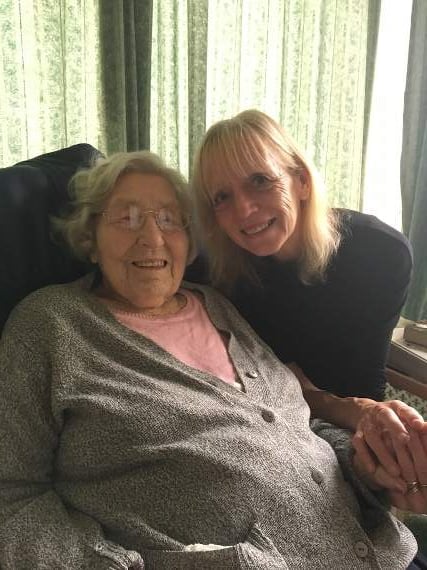
A MOVING testimony about one of the bloodiest battles on the Great War, was given by Joan Parsons, believed to be the last of the First World War widows, shortly before her death earlier this month.
Joan spoke at length about the Battle of Passchendaele, which ended in November 1917 and was, after the Battle of the Somme, undoubtedly the worst conflict of the 1914-18 war in terms of loss and suffering.
And her valuable testimony is an important piece of the story of the Great War, told as it was after being recounted to her by husband Freddie Parsons, who survived both Passchendaele and the Somme and only confided in Joan as an act of love for his wife.
Freddie, who was born in May 1895 and lived in Portsmouth, was 20 when he joined up 1916 as a gunner with the Royal Garrison Artillery, serving until the end of the war in 1918. He returned home traumatised to live with his ageing mother and, like many of those returning from the war, never spoke of what he had been through.


“He was a lonely man when I first met him,” Joan had told her family, which includes niece and goddaughter Mandy Wilson, who lives in Alton, and who told us the story of her aunt and uncle and the bravery of her dad Stanley Budd, Joan’s brother, who fought on the beaches of Dunkirk, where he was shot and wounded.
Mandy, who was one of five sisters, didn’t know what terrible experiences her uncle had gone through until her aunt told her how Freddie had gradually “opened up” and talked of his time fighting in northern Belgium.
Freddie was 25 years older than Joan, who was born Greta but liked to use her middle name, and they married in 1944 and moved into a cottage next to the railway station at Rudgwick. An expert carpenter, Freddie worked on the railways in the days of steam and eventually the couple had three children, Geoffrey, Gill and Alan, and two grandchildren.
“Freddie loved children,” said Joan, “and I think the way he coped with what he had been through was to be so grateful he was alive. He was awarded three medals but never wore them, and in the end he threw them away.
Freddie certainly deserved those medals, as did the men he fought with, because it was through him telling Joan, at last able to talk about, we have such a vivid record of the carnage of the First World War.
Describing herself as a “good listener”, Joan said: “It was still hard for him to recount those war years, but I felt that helped him to talk. I did not ask him, I let him come to me. It did worry him a lot, it was so real.”
The Third Battle of Ypres (Passchendaele), which began in July 1917 and ended four months later, resulted in the death of 325,000 Allied troops and 260,000 Germans.
It became known as the ‘Mud War’ as weeks of driving rain had turned the battlefield into a quagmire in which men drowned and Freddie talked of bodies lying smothered in mud.
“They would have to tread on them. The trenches were full of water and the bodies would be floating. The loss of life and the screaming of the injured and dying men was awful,” said Joan.
“Shell holes became lakes and men were reported as shedding their uniforms as the weight of the slime made it impossible to move.”
The soldiers described it as quicksand, a “monster” which sucked men down, the mud suffocating soldiers who fell from duckboards. It is said more men died from drowning than any other land battle.
Joan also described her husband’s description of the rats, which he couldn’t bear, feeding not only on dead bodies but on the countless dead horses. Used in teams of eight to hoist the huge howitzers Freddie fired, “even these mighty beasts could not plough through the swamp, dying where they fell they could not be moved”.
It was a nightmare for Freddie as he had a love of horses and told Joan that once he stayed up all night with a terrified horse as its life ebbed slowly away.
“This horse had been fatally wounded and he was not allowed to shoot it because every bullet had to be fired against the enemy. He stayed with it until it died but it took a long time and it upset him.”
Passchendaele was the brainchild of General Haig, who has gone down in history as wasting thousands of lives. His aim was to reach the Belgian coast so German submarines could be destroyed, because the destruction of British ships could not be sustained much longer.
At the end of the war Freddie knew he was lucky to survive but never seemed proud of his achievements. However, he found happiness with Joan and their family and died in 1981, aged 86.
“He was a contented man,” said Joan, who had finally found an antidote to his pain.
“I miss the man I loved but we will never forget the sacrifices he and his comrades made for all of us.”
Mandy, who runs a dance and fitness studio in Alton and whose husband Bob used to own Wilson’s Taxis in the town, also has another hero in her family – her father Stanley, Joan’s brother.
In 1940, during the Second World War, he was part of the invasion force at Dunkirk and, according to Mandy, “he lost friends on those beaches”.
“My father was shot, but to escape he killed a German motorcycle rider and wore his uniform to get through enemy lines.
“He killed a pig to survive and the French Resistance took him in and managed to get him back to England. The Army dumped him outside the pub at Rudgwick where his parents lived and his 14-year-old sister was called out from school to come and look after him.
“He was wounded and obviously had post-traumatic stress and the family hardly recognised him he had lost so much weight. A local farmer used his horse and cart to take my father home, but he was so traumatised he couldn’t speak for days. His mum nursed his wounds and got him back to full health.”
Stanley then became a lorry driver, delivering aviation fuel around the south of England, including to Lasham, near Alton, risking being shot by German planes who targeted the lorries. It was at the main depot at Hamble he met his future wife, Jean Williams, who made computers for planes.
After the war, the couple opened Chandlers in Hamble and, after Stanley taught himself how to make sails, founded the successful Rochall Sails in Bosham, near Chichester. When they retired they ran a bed and breakfast in Newquay. Stanley died in 1992 from cancer.
Joan died last Thursday (November 9), aged 96, and Mandy visited her aunt Joan at her Shalford Nursing Home, near Guildford, the day beforeshe died.
“She was well. She always enjoyed a glass of wine and looking forward to her birthday on November 27. On the day she died she was sitting in her chair and just fell asleep and didn’t wake up. We will miss her.”
Comments
This article has no comments yet. Be the first to leave a comment.