
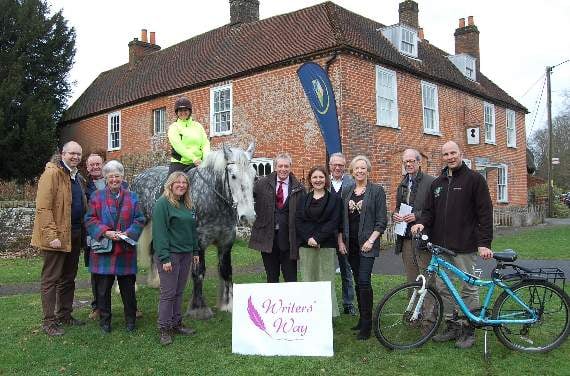
THE new Writers’ Way trail, designed to enable walkers, cyclists and horse riders to enjoy the countryside while following in the footsteps of East Hampshire’s famous and much-loved authors, has received a Merit Award at the British Guild of Travel Writers’ (BGTW) annual UK and Ireland Tourism Awards.
Launched in March, the £191,000 Writers’ Way route was developed and funded by Hampshire County Council (£63,000), the Department for Transport’s Local Sustainable Transport Fund (£110,000) and East Hampshire District Council (£18,000), who worked in partnership to identify the route and to improve many of the paths, including major resurfacing of bridleways, linking existing public rights of way and small, quiet country lanes around Chawton and Selborne.
The Writers’ Way celebrates the authors who were connected to the area in, this, the Year of Literary Heroes.
This year’s UK-wide theme is thanks (in part) to this year’s 200th anniversary of the death of Jane Austen and the 100th anniversary of the wartime poet Edward Thomas – both of whom lived in East Hampshire. Austen’s house, museum and cottage gardens can be visited on the walk.

Telling the story of East Hampshire’s rich literary past, the 13-mile Writers’ Way links the market town of Alton with the picturesque villages of Chawton and Selborne, through glorious countryside. It uses a mixture of paths and rural lanes, age-old sunken tracks, as well as paths over open farmland and woodland.
For a day out with a difference, walkers and cyclists can return to their start point in this linear walk by using the Mid-Hants Watercress Line Steam Railway, as Alton and Medstead stations are close to either end of the route.
The walk begins in the pretty village of Chawton, where Jane Austen lived. She loved the surrounding countryside and often took walks with her family and friends. Passing through Alton, walkers can see the places Jane knew so well – shops and friends’ houses, the bank owned by her brother, Henry, and the coaching inn.
Arriving in Selborne, visitors can discover more about the pioneering 18th Century ecologist and writer Gilbert White, who lived at The Wakes. His wildlife observations and fascination with nature led him to write his hugely influential book, The Natural History and Antiquities of Selborne. It is reputed to be the fourth most published book in the English language and transformed the way we think about the natural world today. His former home and garden make for a fascinating visit.
The trail is also associated with writer, journalist, MP and farmer William Cobbett, who wrote Rural Rides to highlight the difficult living conditions faced by rural families in the 19th Century. For research, he took long rides on horseback through the East Hampshire countryside and was inspired to visit Selborne after being given a copy of Gilbert White’s book.
Other writers connected with the area include wartime poet Edward Thomas (one of his poems, Adlestrop, was once ranked the nation’s 20th favourite poem by The Bookworm), novelist Flora Thompson (author of The Peverel Papers and the classic trilogy Lark Rise to Candleford) and self-taught field naturalist and writer and founding member of the Royal Society for the Protection of Birds WH Hudson (Nature in Downland, Hampshire Days).
The project was nominated for an award by BGTW member Paul Wade, who wrote of The Writers’ Way: “….although the paths have been around for centuries, this simple initiative opens up 13 miles of pretty countryside to walkers (rather than hearty hikers), cyclists and horse-riders who want to follow ‘in the footsteps of Jane Austen’ and other Hampshire authors.”
In an article for The Express newspaper, Mr Wade drew attention also to Manor Farm at West Worldham where a recently opened Featherdown Glamping site can provide charming rural accommodation for people following the Writers’ Trail.
Owned by the Brock family, who have been farming there for a century, this modern addition to the agricultural offering takes the form of “rustic, chic-tented cabins where oil lamps and wood-burning stoves are balanced by running water and hot showers”.
The BGTW award is a bonus for Manor Farm, especially since Mr Wade chose to lay his head there when walking the route, taking a footpath through the meadows to the nearby Three Horseshoes pub for supper, and enjoying the warm croissants brought to his door in the morning.
He writes of his Featherdown experience: “For townies like me, the clean air and rural calm are a treat.”
Commenting on the award, Alton Rural county councillor Mark Kemp Gee, who was heavily involved in the bringing about of the Writers’ Way, said of the project: “So much work went into its creation with a lot of hard and creative work from our rights of way officers at Hampshire County Council.
“We had a soft opening at Jane Austen’s House Museum in the summer to coincide with the 200th anniversary of Jane’s death and many of the paths that make up the Writers’ Way, a contiguous route on country paths circumnavigating Alton, are paths that we know Jane walked when going to Alton and when visiting friends in villages relatively close to Chawton.
“This was also true of the Reverend Gilbert White who, although living in Selborne, was rector of Farringdon and walked between the two villages along the Writers’ Way on a regular basis.
“With wonderful scenery and lovely country pubs, it is a quintessential English country route open to walkers, cyclists and equestrians. There is no doubt in my mind that it will, as it gets better known and appreciated, become one of the most popular country routes in the south of England.”
Comments
This article has no comments yet. Be the first to leave a comment.