
Six thirty in the morning and the wail of the air-raid siren is followed by an urgent robotic voice telling me to find shelter and not be complacent!
If I couldn’t get to a shelter, I was to find a place where two walls separate me from the potential missile impact zone.
I wasn’t in Kyiv where this sort of thing passes for normal and from where I had returned the night before, but at home in Alton: I’d forgotten to delete the ‘Air Alert’ app on my phone.
The app showed me the whole of Ukraine was a red zone and under threat from missile attack from occupying Russian forces.



In mid-February I planned to join a mini-convoy of three other vehicles to drive to Ukraine to deliver humanitarian aid consisting largely of emergency medical items – field dressings, etcetera – generators and electrical gizmos, warm clothing and bits and pieces for the kids and infants.
My mission was a long slog across Europe via Germany, Poland initially to the Ukrainian city of Lviv and then on to Kyiv, seven hours’ drive away.
In Kyiv a local non-government organisation (NGO) was to take delivery of the cargo carried by ‘The Beast’, a Volvo XC90 which had been part-donated by Osgood’s in Alton.
The car was to be handed over along with its contents to the NGO for use by local volunteers to distribute aid.
Other members of the convoy, who hailed from various far-flung parts of the UK, were headed for different drop-off points further afield, some as far south as the recently-liberated town of Kherson, very close to the front line and still subject to the attention of Russian artillery.
To the casual visitor, Ukraine is confusing: ordinary and yet extraordinary at the same time.
You could visit Kyiv and be deceived into thinking that this was a normal, thriving European city... until the missile alerts sound.
On the surface things seem normal: traffic flows, shops and restaurants are open and residents go about their everyday business. The excellent train service is running, the postal service delivers letters and parcels to most parts of the country.
There are a few signs of something not quite right: the ‘hedgehog’ anti-tank obstacles piled up by the side of the road, ready to be deployed and sandbagged military bunkers discreetly settled into the cityscape.
My introduction to the human cost of the conflict began back at the Ukraine border with Poland.
Clearing customs, a young Ukrainian woman introduced herself wondering whether we could give her a lift to Lviv, a city 40 miles away in western Ukraine.
Alla Karpenko had been collecting a set of night vision binoculars from customs to send to the battalion of which her fiancée, Evgeny, had been a part.
Evgeny Bazilevsky was a professional soldier and paratrooper who piloted the battalion’s drone. He was 27 when he was killed in Bakhmut on December 13, hit by shrapnel from a Russian tank round fired 50 metres from his position.
Alla wore Evgeny’s dog-tags with pride along with a small piece of the shrapnel that had devastated his young body. An achingly poignant image of Alla holding her fallen fiancée’s hand with the caption: “I will forever hold your hand, my hero” went viral around the world. Alla has since became a dedicated civilian ‘fixer’ for Evgeny’s battalion, sourcing cars, specialist military equipment and medical supplies to send to the unit on the front line.
These sorts of encounters with the grieving are not uncommon but had a dignity in their restraint, as if there would be enough time to grieve when this was all done but right now there was a war to win.
No public displays of grief then, just a haunting sadness and a genuine puzzlement why Russia should behave in such a savage and brutal way against a peaceful neighbour, precipitating an unwanted and unwarranted conflict that would result in the deaths of so many young men on both sides.
The head of an agricultural and forestry college we visited in Lviv lost his son not long after the start of the war. He carried his grief with a solemn dignity that he channelled into supplying his son’s battalion with the life-saving battlefield medical supplies we carried from the UK in myriad boxes.
No fuss, just a quiet gratitude for what the UK was doing for the country.
It was during that visit an air raid alert sounded: the college’s students decamped to the basement that served as a shelter while the adults displayed a levity and sang froid born out of the tiresome but potentially deadly daily routine of missile alerts.
So on to Kyiv where my car and cargo were delivered to another Alla (Nalyvaiko) who runs the NGO with whom I’ve been connected for a while with the Energise Ukraine campaign which bought generators to send to the country.
After a night in Kyiv, the remaining three cars dispersed to regions of east and south Ukraine to drop off their precious cargo of medical supplies and two more of Energise Ukraine’s generators.
From apparent normality, things change markedly once you get into the suburbs of Kyiv.
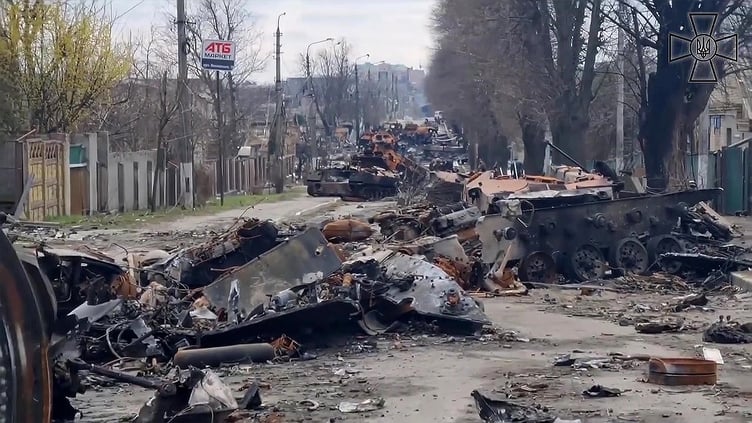
Irpin and the now-infamous Bucha bear the scars of a fierce and brutal battle to prevent the encirclement of Kyiv by Russian forces. For a two-week period in February and March 2022, a tank battle raged inside Irpin and Bucha, both on Kyiv’s doorstep, while Ukrainian infantry engaged Russian paratroopers who had deployed on a nearby airfield.
The Ukrainian forces used rockets, artillery and air strikes to halt the Russian advance.
More than 200 Russian tanks and armoured vehicles were destroyed or damaged on a nearby road leading into Irpin. By the end of March, Ukrainian forces had driven out the invading Russian army.
Despite fighting raging all around, nearly 20,000 people were evacuated from Irpin and Bucha. A few days after the recapture of Bucha on April 2, 2022, news reports and videos emerged showing streets in Bucha covered with the bodies of some 280 civilians; among those killed were women and children. Most had been shot.
The International Criminal Court is investigating the very real possibility of war crimes being committed here.
Irpin had saved Kyiv from being overrun and was accorded ‘Hero City of Ukraine’ status – but at a withering cost in human lives and damaged property and infrastructure.
I was awestruck by what I saw but when asked what the devastation in Irpin meant to my NGO host Alla, she said: “We are beyond anger – it just makes us so sad.”
The cost to civilians and their property was immense although driving through the area the random nature of the devastation is perplexing. Some residents were clearly just lucky and their properties escaped unscathed or with minor damage while the house or apartment next door might be a ruin.
Many of the evacuees who were rehomed in the UK in the early days of the war came from the area of Irpin and Bucha. Prefabricated ‘modular houses’ replace some of the damaged properties but are only a rather inadequate stop gap. Some of Energise Ukraine’s generators are also deployed here.
There is commendable urgency by the local authorities to get things back to some semblance of normality. A large modern shopping mall had just opened in Bucha when the Russians came calling.
It was completely destroyed in the fighting, only to rise from the ashes within the year: it has been rebuilt and is open again.
However, many of the private houses and apartments in Irpin, so familiar from television news coverage of the war, remain burnt-out shells, witness to the savagery of the fighting.
‘Invincibility Centres’ are a frequent sight on the streets: pop-up facilities housed in tents, cabins, schools or municipal buildings that enable displaced residents to get a warm meal and an opportunity to charge their phones and laptops. Many of Energise Ukraine’s generators have been deployed to service this vital sector.
Ukrainians’ spirit is strong – they endure missiles and bombs and they are not cowed. They demonstrate a resilience which has commanded respect and admiration globally and particularly with many in the United Kingdom.
A resolute connection has developed betwixt our two nations that defies a rational explanation but may have something to do with Brits abhorring bullies and a tendency to support the underdog.
An affirmation of that bond, if needed, is expressed by genuine gratitude for the UK’s support. Ukraine has not forgotten the UK were among the first to offer both humanitarian and military aid after the Russian invasion on February 24, 2022. I have yet to meet a Ukrainian anywhere who will countenance anything other than a comprehensive victory. Of the ceding of territory to Moscow, they are resolute: “Not a single square metre – we don’t want to live like Russians.”
But the country is enduring considerable pain and loss as the war continues into a second year. One Ukrainian commentator admitted: “We don’t make plans any more because there might not be a tomorrow for us.”
Back in Alton and an hour after the air raid alert on my mobile, the all-clear is sounded with the app’s robotic voice adding with a smidgeon of irony: “May the force be with you..!”
Until the next time. Slava Ukraini…!
“
We don’t make plans any more because there might not be a tomorrow for us.
Ukrainian commentator
Comments
This article has no comments yet. Be the first to leave a comment.