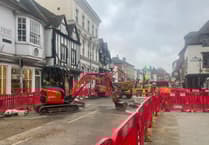
A PLEA for Surrey County Council to give the highest priority to the Hickley's Corner underpass and the need for a Wrecclesham bypass has been made by the Mayor of Farnham, Sheila Scrivens. The deferment of the underpass scheme was described by Mrs Scrivens as "a major disappointment" in an address to the county council's local committee in Waverley. "We are looking to Surrey to reaffirm its absolute commitment to this project," she said, adding that "nobody these days would design a bypass to bisect a town as the A31 does Farnham". She recalled that for many years the town council has been asking for a 50 mph speed limit on the A31 from the Waverley Borough Council boundary on the east to the Hampshire County boundary to the west. But apart from a short stretch either side of the Hickley's Corner junction, this request has not been agreed to and most of the road remains at 70 mph. The result, she said, was a dangerous speed for the conditions. The grass cutting problems caused were such that at the Coxbridge roundabout, for instance, a lane has to be closed for the mowing, and a single cut not only causes traffic chaos in the town centre, but costs £15,000. "As we now have ghastly steel barriers on the central reservation, perhaps the county will take up the town council's offer, made some time ago, to plant the central reservation," she suggested. And speaking of the need for a Wrecclesham bypass, she asserted: "It is intolerable these days that such volumes of through traffic are allowed to make life in the village such a misery. "The spread of traffic, especially lorries, through south Farnham derives from this problem and given the expectation of significant housing growth in the Bordon area, traffic levels are expected to rise even further. "Again we look to the county to accord the Wrecclesham bypass the highest priority and to work with Hampshire to make the A325 fit for it's purpose – namely a key traffic artery." Turning to other traffic matters, Mrs Scrivens said: "Most people remain of the view that the centre of Farnham will remain vulnerable to deadlock until the A287 is re-routed. "From today's perspective that is probably a pipe-dream, but the work on urban safety management commissioned by Farnham Town Council is providing the expertise and the ideas to address our various problems in and around the town centre. "We are pleased that Surrey are working with them and, we dearly hope that significant amelioration of our number one issue will be forthcoming, We understand the planning and cost constraints, but clearly the creation of a much more pedestrian friendly town centre has real resonance with the people of Farnham, and is the least we can do to preserve the town's special and distinguished built heritage." On the subject of car parking, the mayor spoke of the town council's hope that edge of town parking will become a reality, and that increased parking at Riverside will flow from the East Street development. "But clearly the question of greatly increasing the capacity of the station car park must be high on the agenda, not only to enable park and walk but to mitigate the spreading blight of on-street parking by commuters in south Farnham," she added. In her wide-ranging address, Mrs Scrivens went on to raise numerous other issues on which the town council has concerns - from HGV lorries passing through Farnham and indiscriminate commercial deliveries to the threat of new development pressures implied in the South East Plan and the need for affordable housing. She referred to the threat of proposed new sand and gravel pits in Monkton Lane and extensions of existing sites in Alton Road and Runfold. "Other counties have included large buffer zones around sites as policy, thus alleviating the effects of noise and pollution, especially when the pits are subsequently used for landfill. We urge Surrey County Council to rethink it's policy on these issues. We have been saying the same thing for years, but you do not seem to be listening." Mrs Scrivens also raised "the disturbing trend in planning applications, namely for the demolition of perfectly sustainable character houses built between the wars and their replacement with blocks of flats, mainly outside the central area, often well away from services and facilities, including public transport and generally with single bedrooms and inadequate parking support. "This malaise is systematically changing the face of 'suburban' Farnham, introducing excessive density, poor design and serious loss of neighbourhood character," said the mayor. "Clearly the government of the South East and now the Regional housing Board are instrumental in promoting this undesirable pattern, but a wide cross-section of the Farnham public see this as yet another degradation of Farnham's distinctiveness."