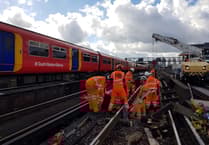
RAIL passengers are increasingly resorting to their cars following the controversial timetable changes on the Alton and Farnham line to London. The addition of anything up to 20 minutes' added time on journeys that are off-peak, though still often used by commuters, has tipped the balance between convenience and speed. So it was claimed at the annual general meeting of Alton Line Users' Association, where the concensus was that the longer journey times had been built into the timetable to save South West Trains from being fined for the lateness of trains. Chairman Chris Campbell even spoke of five commuters now away from work with stress- related illness since the new timetable came in in December, bringing with it "the slowest off- peak timetable between Ash Vale and Alton sine the 1930s". Members of the rail users' pressure group were pulling no punches, faced with the opportunity to grill James Burt, commercial director of South West Trains, at their annual general meeting. Mr Burt found himself arguing against a barrage of claims that when trains have to be cancelled, it is always the Alton, Bentley and Farnham passengers that miss out. "You want to get people to Portsmouth and Southampton and Basingstoke. We are a tiddly little line and if something has to go, we are the ones that suffer," it was asserted. It was unfortunate for Mr Burt that the meeting came towards the end of a week in which passengers bound for Waterloo had suffered appalling disruption, in part caused by the heatwave. Monday had brought a points failure at Waterloo and a wiring fault at Basingstoke, on Tuesday a track circuit at Weybridge failed in the morning peak and on Wednesday a track circuit failed at Clapham Junction. Worse still, yet more problems on the Thursday evening meant that many commuters didn't make the line users' meeting at all. Frustrated travellers spoke of communications as "an absolute PR disaster" when things go wrong. One Alton-bound train that week breezed through from Waterloo without stopping until Ash Vale, leaving passengers at stations between "left like prize idiots". Another man spoke of a four-hour wait for a train at Bentley, where staff tried and failed to gain any information about when a train might come. Steve Hooker, speaking for Network Rail which is responsible for maintenance, confessed: "This week has been absolutely awful, and I apologise." He went on to explain that the volume of failures in general had fallen. Network Rail had inherited an infrastructure that "wasn't as good as it should be" and the system had a legacy of "good enough" engineering. A lot more money was being put into maintenance, a lot more work was being carried on at night and it had been possible to reduce the reliance on contractors by 70 per cent. "But we are only just getting back to where we were pre-Hatfield," he explained. James Burt spoke of a 19 per cent improvement in the reliability of trains running off-peak and a 14 per cent improvement overall. There were now 40 per cent less complaints about punctuality. Pat Lerew, for Alton Chamber of Commerce, commented: "If you keep moving the goalposts, of course you meet your targets." She focussed on the 08.44 from Alton (08.56 from Farnham) as a "dire" service which takes one hour 15 minutes, only ever has four coaches and on which passengers have to stand from Ash Vale. "By the time you get to Surbiton, it ressembles the tube," she claimed. A particular bone of contention were the "dwell times" that have been built into the new timetable, with minutes wasted at stations where hardly anyone got on or off. "Every single station you sit and wait and wait in the middle of nowhere," it was claimed. James Burt pointed out that the old timetable hadn't been seriously revised since 1967. "The old timetable wasn't working. In general, people prefer to arrive at the time we said they would. The trains were not taking those times, they were taking longer. Network Rail said we were trying to run an impossible timetable." In addition, he pointed out, the new Desiro trains behave differently to the old slam door ones, which have fewer doors and therefore take longer in the stations. "The new rolling stock, we were told, would be faster, not slower," argued one line user. Mr Burt stressed that the new timetable had taken two years to plan. he said that the possibility of reducing dwell times could be looked into, though only for the stations between Alton and Woking.