
TEMPERS flared once again at the June meeting of Four Marks Parish Council as revisions to the regulations governing the village burial ground were discussed.
Following a lengthy and emotional series of debates on the controversial subject, the issue was put on the parish councilÕs agenda so that a possible resolution could be agreed.
The burial ground has been a controversial topic in the village ever since the parish council ordered the removal of various items from the grave of Jack Innes, a-four-year-old boy killed in a tragic fairground accident in Spain.
Some 23 members of the public attended the meeting, along with a police officer to keep order.


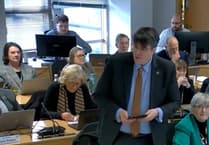
The audience contained various members of the Four Marks Action Group, a recently-formed group of residents who have taken exception to the parish councilÕs actions over the cemetery
Since members of the public are not allowed to speak during parish council meetings, their views were represented by parish councillor Bryan Timms, who has been consulting with the group over an extended period.
Council chairman Peter Hobbs invited Mr Timms to put his proposals for reform. To explain the reasons for his proposals, Mr Timms wanted to look at the history of the situation with particular reference to the grave of Jack Innes, and to look in detail at a survey of local opinion, produced by the Four Marks Action Group.
The chairman interjected, saying that these factors were irrelevant to the item that appeared on the agenda.
Repeated attempts by Mr Timms to explain his proposals were vetoed by the rest of the council for this reason, forcing Mr Timms to make his proposals without making his case. This proved highly unpopular with the crowd.
His first proposal was to produce an acceptance document that has to be signed by the undertaker or person representing the graveholder, before a burial takes place. A signature on this document would mean that the rules have been read, understood and accepted by the undersigned, meaning that notification of the rules would be a matter for the undertaker. This proposal was subsequently agreed.
Mr Timms was then brought to his next proposal, which was to suspend the enforcement of the regulations. He said: ÒIt is a fact that we let the Innes family believe for almost two years that they were doing nothing wrong, and then we pipe up a month before the anniversary of JackÕs death. Is that compassionate?
ÒIn nine or 10 months time, there is an election. We donÕt need to make a decision now, weÕve been letting it go for three years. Let it be considered by a fresh, new council. I propose that we suspend enforcement of the current regulations until May 2003.Ó
Much to the surprise of Mr Timms, no seconder came forward for this proposal, meaning that it was duly dismissed.
Burton Mills then made his own suggestions for amendments to the regulations themselves. He proposed that the rule disallowing Òwooden memorials of any sortÓ should be amended to allow on a temporary basis, wooden crosses that have been agreed by the parish council. Mr Mills identified a period of six months to define ÔtemporaryÕ, but other councillors felt that a period of 12 months would be more appropriate.
His next suggestion was that the rule disallowing artificial flowers be amended to accept silk flowers that the parish council deems to be in good condition. This was agreed by councillors, but it was stressed that plastic flowers must remain prohibited.
Mr Mills then proposed that the rules requiring a vase, cross or headstone be amended to stipulate that vases and crosses be made of stone, except on a temporary basis. The council agreed this proposal.
Mr Mills expressed concern that there were no rules governing exactly where on a grave memorials, specifically shrubs and plants, can be placed. He said that having plants on the edge of a grave may cause loose soil against an adjacent grave.
He suggested that plants should be rooted in the middle of the plot leaving a one-foot border around the edge. This was agreed.
In the majority of cases, Mr MillsÕ proposals were carried by a majority vote, with all but Mr Timms supporting them.
Mr Timms then expressed concern that the current regulations made no reference to enforcement, and proposed that any communication, reference or contact concerning the possibility of enforcement come through the council. This was seconded and agreed by councillors.
The way in which enforcement is carried out was also raised. Mr Mills suggested that when enforcement is to take place, a date should be set and a quorum of councillors should be assembled.
Mr Timms asked what would happen if a quorum could not be assembled, to which Mr Hobbs replied that it was a question of councillors Òputting their money where their mouth isÓ. Again, all councillors were in favour of the proposal, except Mr Timms.
It was at this point that an outburst took place from one member of the audience. The man had to be escorted out of the meeting by Pc Clive Brown, after threatening to take action against anyone trying to remove items from a particular grave.
The villagers who attended the meeting were clearly dissatisfied with the way the meeting had gone, and Pc Brown had to stay at the village hall until the public had dispersed.
The agreed reforms to the rules will take effect on Sunday June 30, and enforcement will begin 28 days after this date.