
In 1914, few families in the country committed their personal circumstances so totally to the war effort as the Andersons, writes Derek Carpenter. Mrs Amy Anderson and Major Rupert Anderson converted their family home, Waverley Abbey House, where they had lived since the turn of the century, into a military hospital.
Amy became a Commandant of the Red Cross before the war and took control of the hospital she had created. Her four daughters served as nurses and her son, Rupert, fought as a Second Lieutenant. Her husband, Rupert, served the Tilford and Farnham community in a variety of committees and posts. The house was restored to the Anderson family’s use in 1919, but their service to the community continued.
In 1927, it was agreed that the diocese of Winchester would be divided to produce two new dioceses, each with a new bishop. Farnham and its castle became part of the new diocese of Guildford.
The castle’s condition and position were not considered ideal as a residence for the Bishop of Guildford. Many voices within the Church believed that money spent on making it truly suitable for this new role — an estimated £20,000 — would be wasted when the building of an entirely new cathedral and residence at Guildford was planned.


_-004.jpeg?width=209&height=140&crop=209:145,smart&quality=75)

It seemed more logical to invest in the promise of something new in Guildford rather than spend money on the old at Farnham.
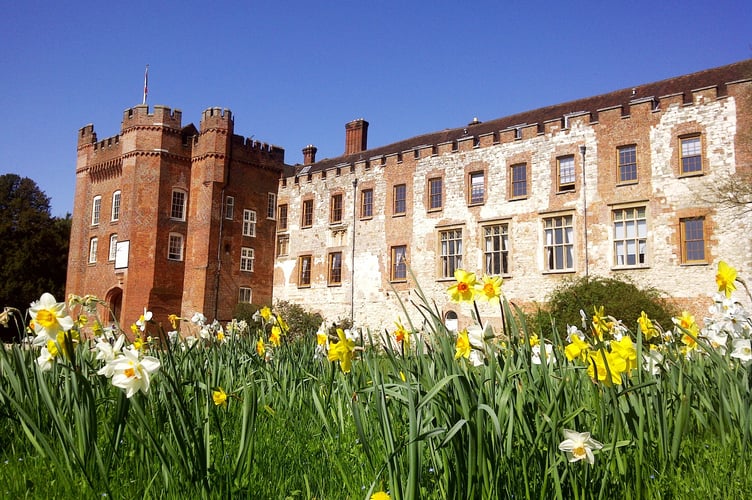
Rather than see the castle left to decline, Amy Anderson OBE became chair of a committee set up in 1930 to promote the use of the Castle as a residence for the new Bishop of Guildford, while at the same time saving the fabric of the Bishop’s Palace for the people of Farnham.
The idea was, perhaps grudgingly, accepted by the Ecclesiastical Commissioners, but only if the money required could be raised by the committee within six months and not be reliant on the Church. In today’s terms the amount required would be about £1.25 million.
The Andersons had considerable personal and family connections in the Farnham area and Amy set about meeting the challenge. Using her influence to secure the support of wealthy contacts, she succeeded in meeting the demanding timetable set by the Church, and work on the Bishop’s Palace commenced. Part of it was cleared and renovated for the Bishop’s family’s use and part for use by religious retreats. A rather dilapidated Tudor wing was made into suitable accommodation for visitors.
A delayed start to building work in Guildford due to the Second World War, post-war building restrictions and constraints, and significant underfunding considerably slowed the Church’s schedule.
Guildford Cathedral was not consecrated until 1961. It was therefore convenient that the work done on the castle provided very acceptable accommodation for the Bishop of Guildford, John Greig, from 1933 while he waited for his new home.
Amy Anderson’s contribution to the history of Farnham Castle and the Bishop’s Palace was not for personal benefit or advancement. Her focus was on retaining it as a central part of Farnham’s history. Money spent on repairing roofs and windows, renovating stonework and woodwork, and making the buildings habitable and suitable for specific practical uses was largely invisible. But all the work her fund-raising efforts made possible was totally invaluable.
Without her support and work, today’s Palace visitors might be walking around a ruined building, trying to imagine it in its former glory, rather than enjoying it as others for centuries have done. It is easy to pass the two small features recognising Amy Anderson within the Palace.
Her painted portrait by Peggy Bell hangs halfway up the fine grand staircase, but not prominently. A wooden commemorative plaque hangs in the Norman Chapel — perhaps the part of the Palace that benefited most from the work done at this time — but that too is easily passed or overlooked without prior knowledge of, or interest in, her contribution.
Derek Carpenter is chairman of the Farnham Castle Trust.
Comments
We've recently changed our login process. If you have an account for commenting, you will need to re-register on the login window.
This article has no comments yet. Be the first to leave a comment.