
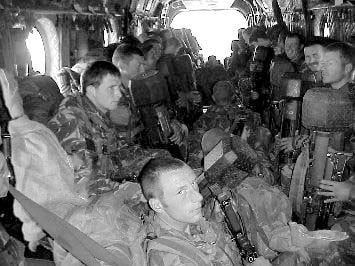
EIGHT helicopter crews from RAF Odiham were among the first NATO troops to cross the border in this week's dramatic international operation to liberate war-torn Kosovo.
Following a tense and confusing day which had threatened an unexpected stand-off between NATO and Russia, the Odiham detachment was ordered in at dawn on Saturday, their brief to fly down the mountainous Kacanik Pass and into southern Kosovo.
They were carrying Paras from the 5th Airborne Brigade based at Aldershot, the task being to set them down in key positions along the route in preparation for troops following later in the day.
According to Wing Commander Martin Sharp, who took part in the operation, the job of the paratroopers was to check the route for mines and booby traps and to offer protection for the British contingency of the peace-keeping KFOR force.



On Sunday the helicopters were in action again, carrying those same paratroopers into the Kosovan capital of Pristina so that they could conduct street patrols through the city.
The Wing Commander said that since their arrival in Macedonia ten days ago, the Odiham detachment had been working very long days in soaring temperatures. But, he assured, conditions were better than expected.
Aware of anxiety among families back home he told The Herald: "The Serb forces are generally compliant and while there is a potential risk to helicopters, no significant action or threat has materialised to date."
He pointed out that his crews had been thoroughly briefed on potential danger from landmines and operational tactics took account of that threat.
Furthermore, because the Odiham crews and Aldershot- based Paras have exercised together for years, they have developed a good working relationship which, because the NATO operation is treading a changeable political and strategic tightrope, is holding them in good stead in Kosovo.
Weather conditions, he added, had been favourable for flying with one or two thunderstorms but nothing to interfere with the task in hand. Still based under canvas at Skopje airport in Macedonia, and working alongside five Pumas from RAF Benson, the crews are now flying on a daily basis into Kosovo, moving troops, equipment and supplies, as well as evacuating casualties and prisoners.
Flying time to Pristina is about 30 minutes, the Chinooks being "fast and responsive" across the Kosovo area which, said the officer, comprises mountainous terrain, rising to 9,000 feet along the Albanian border where some peaks are still covered in snow.
Operating in hot and humid conditions with ground temperatures in the mid 30s, one of the principal tasks is to maintain a constant supply of water for troops on the ground who are carrying heavy equipment, weapons and ammunition. "They carry their lives on their backs," said the Wing Commander, "and they need water to keep them going".
Flying across the Kosovan countryside, he has witnessed at first hand the destruction of war but, he said, compared to the ravaged plight of Bosnia and in particular Sarajevo, the picture is not as bad. "The destruction seems more isolated and selective in Kosovo, some properties appear intact although they may be ransacked and looted."
It was Odiham helicopter pilots who first spotted, from the air, mass graves outside the tiny village of Kacanik. "They were close to a pick-up point but out of sight of ground forces," according to the Wing Commander who said that any such sightings are reported immediately for further investigation by ground-based troops.
Having left his men working in Kosovo, Wing Commander Sharp is now back at Odiham and is keen to stress the major role those at home have played in getting the airborne operation off the ground.
He explained how the week before the call-out the eight Chinooks now in the Balkans had been on exercise with the 5th Parachute Brigade in north west Scotland. On returning home they had been called up at very short notice to deploy to Macedonia.
"Aircraft always require a lot of maintenance after exercise and the ground crews had to work long hours to get them ready in time. In addition, staff had the task of gathering the large amount of supplies and equipment required for what is a huge operation," he said.
At the same time, the local base is continuing to support operations in the Falklands and Bosnia, and there will be no degradation of these committments," said the Wing Commander.
He assured too that although there was, as yet, no indication of how long the effort in Kosovo would have to be sustained, "we have the capability to see the operation through".