
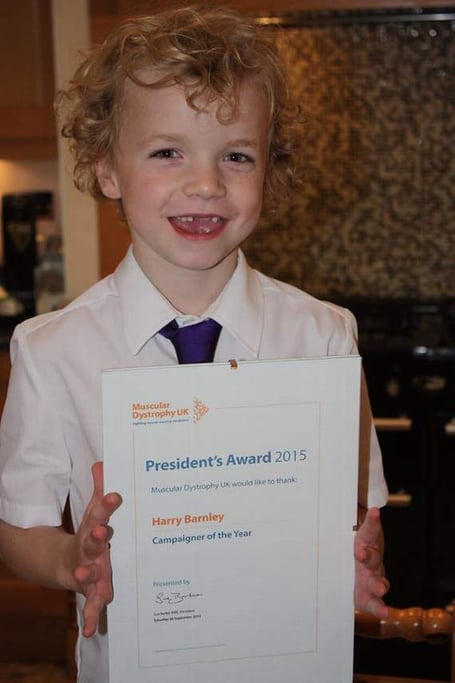
THE Barnley family from Farnham are over the moon after news that funding for Translarna, used for treating children aged five and over suffering from Duchenne muscular dystrophy has been approved – meaning that their son, Harry, could be walking for longer.
The decision recommended by NICE, The National Institute for Health and Care Excellence, heralds the first time ever a drug tackling an underlying cause of Duchenne muscular dystrophy has been available through NHS England.
Harry’s parents have endured an 18-month-wait, with repeated delays and setbacks for news on access to Translarna, which could allow eligible children to keep walking for longer.
Most with the condition become entirely reliant on a wheelchair before they reach the age of 12. There are thought to be around 50 children in England who could be helped.




Last year a group of families delivered hand-written letters to Number 10 and met the Prime Minister to appeal for his help. One was William Cobbett Primary School pupil Harry Barnley, who was diagnosed in June 2013.
Harry’s family set up the Help4harry campaign to raise awareness and funds for the deadly condition, which could leave Harry wheelchair-bound at the age of 10.
In the EU there are around 18,600 children and adults living with Duchenne muscular dystrophy and around 2,600 in the UK, almost all of them being male.
The condition is caused by the shortage of dystrophin, a vital muscle protein, which leads to muscles weakening and wasting over time. Due to the severity of the condition which affects the heart and breathing muscles, many sufferers do not make it beyond the age of 30.
Harry’s mother Sue said: “It is just the best news we have had for a while, I can’t tell you the relief we felt and still do feel at the news.
“It definitely feels like a huge weight has been lifted, but it is important to say we can’t stop fundraising and raising awareness as this is still 100 per cent fatal and we still need to find a cure.
“We’re not sure when we will get the drug, we have been told at the earliest the end of June and the latest August this year – we can live with that.”
Research has predicted that Translarna could delay loss of mobility for up to seven years.
Sir Andrew Dillon, chief executive of NICE, said: “Duchenne muscular dystrophy is a cruel disease that currently has few treatment options. Ataluren [Translarna] is a medicine that for the first time is aimed at the root cause of the disease and has the potential to offer benefits to people with the condition and their families.
“Because of its very high cost, it is important that details of the financial and other arrangements to enable this new medicine to be offered to patients on the NHS are discussed and agreed between the company and NHS England, and set out in a managed access agreement.
“NICE acknowledges that ataluren represents a significant cost to the NHS at a time of increased pressure on funding and has considered this carefully against the uncertainties of its potential long-term benefits.
“This is why the committee has recommended the drug be made available for an initial period of five years, under strict conditions to allow more data to be gathered on its efficacy, before the guidance is reviewed and a further decision made on whether funding should be continued.”
Comments
This article has no comments yet. Be the first to leave a comment.