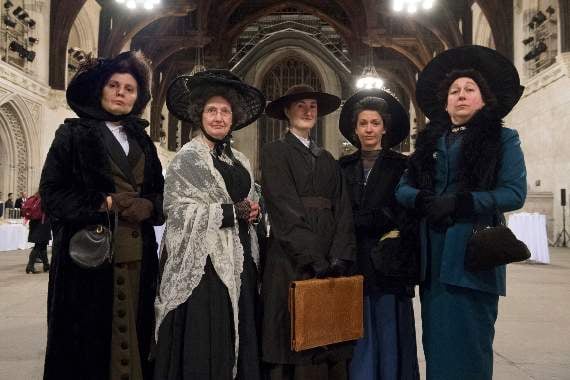
TAKING centre stage during Parliament’s celebrations for the centenary of women’s suffrage in Westminster earlier this month, were Witley-based historical interpretators Past Pleasures.
Playing the roles of Emmeline Pankhurst, Emily Davison, Nancy Astor and fellow campaigners, the group was there to turn the clock back to 1918 when Prime Minister Theresa May launched #Vote100.
That started a year-long series of events and exhibitions commemorating the women and men who fought to achieve electoral equality.
It was exactly 100 years to the day after the Representation of the People Act was passed, which extended the right to vote to all men over 21 and the first women, one of the most important milestones in British democratic history.

The centenary year also marks the anniversaries of three other significant milestones in the fight for universal suffrage and, for the the first time in history, the Parliamentary Archives displayed all four original Acts of Parliament together.
The 1918 Parliament (Qualification of Women) Act, allowed women to be MPs – the Equal Franchise Act, which followed in 1928, gave women the vote on the same terms as men while the 1958 Life Peerages Act, allowed women to sit in the House of Lords as life peers.
The Haslemere branch of the Nation Union of Women’s Suffrage Society was formed in 1908 and a photo from 1912 (below) shows militant members marching down the High Street bearing their banner, ‘NUWSS Non-Militant Portsmouth Road’.
Haslemere’s Suffragettes had a more famous banner which was made by the nearby St Edmundsbury Weaving Works at College Hill, Haslemere.
It carried the slogan ‘Weaving Fair and Weaving Free England’s Web of Destiny’ and was noted by the Surrey Times newspaper for being particularly beautiful in a report from June 1908, after it was carried on the Women’s Sunday suffragette march in London, where 200,000-300,000 people gathered in Hyde Park, one of the largest single demonstrations of the Edwardian era.
The first branch secretary recorded was Mrs Marshall, who lived at Tweenways, in Hindhead, followed in 1910 by Miss Rees.
The branch opened a shop at The Gables, in Haslemere, to boost its campaign for the 1910 general election.
Shockingly, the day after the 1912 march through the town, a porter at the railway station discovered a clockwork time bomb with a ‘Votes for Women’ label. He disabled it by plunging it into a pail of water.
Written on the note inside, addressed to Haslemere Urban District Council, was: “Have we your sympathy? If not, beware!”.
Museum collections manager Lindsay Moreton said: “Haslemere played host to leading American suffragette Harriet Stanton Blatch in 1901, when she came to stay in one of the houses connected with the Haslemere Peasant Arts Movement.
She was in the area to study working conditions of rural women in England.”
The towns womensfolk took to the streets again to protest in 1977 for a re-enactment of the 1912 march for the town pageant to celebrate The Queen’s Silver Jubilee.
Residents Fay Foster and Maureen Toynbee dressed up as suffragettes, led the procession down the High Street. Mrs Foster, who has been a town councillor and a stalwart of the Women’s Institute in Haslemere, said: “We all sang the special song, ‘The March of the Women’.”
“This was broadcast from the windows of what is now the dry cleaning shop next to East.
“It was a fantastic day with celebrations throughout the town and displays on Lion Green,” she added.
Comments
This article has no comments yet. Be the first to leave a comment.