
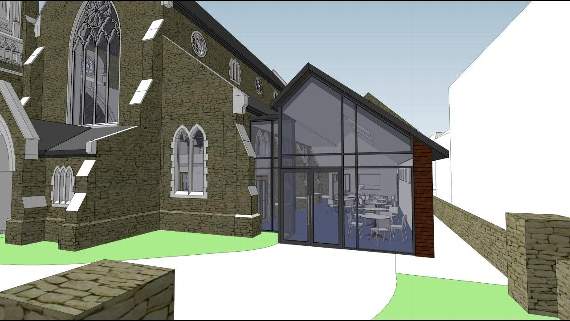
PLANNING watchdog The Farnham Society has “strongly objected” to planned building works at The Spire Church, formerly the United Reformed Church, in South Street.
The iconic church submitted plans to Waverley Borough Council for new extensions and alterations, following the partial demolition of an existing extension designed by the late Farnham architect Arthur Stedman in 1929.
The church says the planned changes are vital to transform “elderly and tired buildings into a continuing and sustainable community hub”, meeting a “growing need” for community space in the middle of the town and “preserving an important Farnham landmark for future generations”.
But in its formal response to Waverley’s consultation, the Farnham Society expressed “serious concerns” that “the proposals will have a significant adverse impact on the listed church building, the site, the street scene, the conservation area and Farnham”.


“The quality and content of the drawings submitted for planning approval are very poor and, in our opinion, insufficient considering the works are to a listed building within the conservation area,” added David Howell, writing on behalf of the Farnham Society planning committee.
The independent watchdog, whose vice president Michael Blower took over Stedman Blower architects in 1968 following the retirement of Arthur Stedman’s son Leonard, has also questioned the “thoroughness” of the listed building consent granted under the United Reformed Church’s Ecclesiastical Exemption process.
Mr Howell continued: “The Ecclesiastical Exemption process is required to be open and transparent and requires consultation and engagement with local communities, local planning authorities, Historic England and National Amenity Societies. The Farnham Society is included in this requirement. No approach was made by the Synod.
“The applicant has a duty, resulting from the Listed Building status of the church to safeguard it and, we argue, the attached buildings, for future generations. Implementing the works proposed would be a failure to act appropriately and responsibly.”
Responding, The Spire Church minister, Reverend Michael Hopkins expressed his “sadness” at the society’s objections, adding “as custodians of this fine building we take our responsibility for its preservation very seriously”.
He said the church boasts “a small but busy” café, is a popular concert venue and its meeting rooms are used by more than 30 community groups but added: “We cannot go on without making changes to our buildings.”
“Not only is routine maintenance requiring ever increasing sums year-on-year, but replacement of all the major building systems will be required within the next five to ten years, which is orders of magnitude beyond what we will be able to fund, and in exchange for spending that amount of money, there would no enhancements to the worn out and shabby facilities that we have to offer,” he continued.
“So, if we do not undertake this project, it is possible that the building may have to be closed, declared redundant, and sold on the open market.”
The “ambitious plan” therefore, as outlined by Rev Hopkins, is to re-new the church’s “outdated” pebble-dash extension to the rear, which he described as like a “derelict workhouse” – creating a new simpler, brick-built single storey hall and meeting rooms, kitchen, and other accessible facilities “in keeping with the adjoining brick cottages”.
This will be combined with “essential” renovation work to the exterior stonework, including the church’s iconic spire, new heating, lighting and sound systems, and an improved café.
Addressing concerns over the church’s Listed Buildings consent, Rev Hopkins said the United Reformed Church, which owns the building, consulted national amenity societies as required by the government, and “some changes to the design were made in response”.
Two public exhibitions were also held, and Rev Hopkins claims “there was overwhelming support to the plans at all stages from the community”.
“Many groups have given their time and resources to help our fundraising,” he said. “We find it sad, therefore, that the Farnham Society has felt the need to oppose the project so strongly.”
Comments
This article has no comments yet. Be the first to leave a comment.