
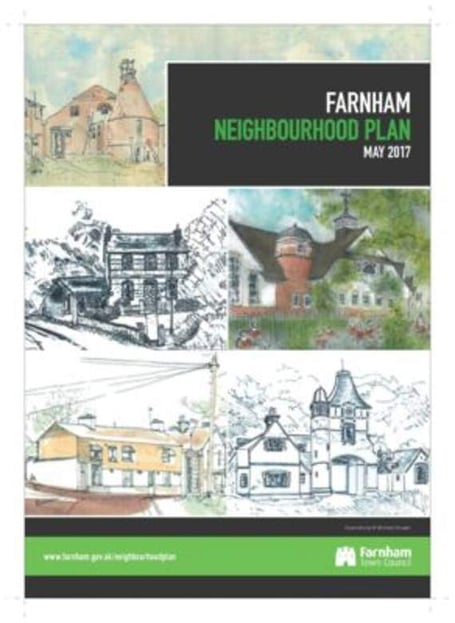
A GOVERNMENT inspector’s decision to find Waverley Borough Council’s Local Plan ‘sound’ has dealt a “cruel blow” to the 10,000-plus Farnham residents who voted through the town’s Neighbourhood Plan last summer - sending the community-led planning blueprint back to the drawing board and requiring sites to be found for an additional 450 homes in Farnham.
Farnham Town Council has confirmed an early review of its hard-earned Neighbourhood Plan is now a formality in the wake of inspector Johnathan Bore’s decision, despite the plan only being adopted last July after winning the backing of 88 per cent of voters in a referendum and defeating a consortium of developers in the High Court.
It comes after Mr Bore published his report on ‘part one’ of Waverley’s own Local Plan planning blueprint this week, concluding that the document provides “an appropriate basis for the planning of the borough” subject to a number of modifications.
Most notable among these modifications is a 14 per cent increase to the borough’s housing requirement to provide a “minimum” of 11,210 dwellings, or 590 per annum, over the 19 year plan period from 2013 to 2032 - in part to meet a proportion of Woking’s unmet housing need.



Controversially, Waverley has decided to allocate the lion’s share of these additional homes to Farnham, upping the town’s own housing target from 2,330 to 2,780 - which Mr Bore agrees recognises Farnham’s position as the borough’s “biggest town, with a good range of shops, services, social and transport facilities”.
This has major ramifications for the Farnham Neighbourhood Plan, which the inspector has warned as a result does not identify enough housing sites to meet demand in the area and as such faces an early review - dismissing Farnham Town Council’s calls for the plan to be reviewed later in its own 18-year lifespan, spanning 2013 to 2031.
Mr Bore said of Farnham’s plan in his report: “The amount of housing allowed for by the Neighbourhood Plan is too low, being based on the submission [Local Plan’s] housing requirement, which is unsound. That does not make the Neighbourhood Plan itself unsound, but further housing allocations at Farnham will be necessary.”
Responding, Farnham Town Council leader and the chief architect of Farnham’s plan, Carole Cockburn, said “disappointment doesn’t come close” to expressing her thoughts on Mr Bore’s report.
“After five years of work by hundreds of local residents, supported by thousands more, this is a cruel blow for Farnham and its desire to shape its own future,” Mrs Cockburn told the Herald.
“Let me make something clear, my disappointment is not about numbers. I no more want to see additional housing allocated now to Cranleigh than I do to Farnham and certainly would not wish to pass on another 450 dwellings to existing settlements in the east of the borough or elsewhere.
“My disappointment is all about timing. Waverley Borough Council had options but chose to allocate 450 homes to Farnham now. This has immediately lessened the strength of the Farnham Neighbourhood Plan in the borough’s defence of the five sites currently at appeal with the Secretary of State or planning inspectors.
“If every appeal is allowed, there will be 570 additional dwellings on sites which were not selected by residents of Farnham and the development of which will destroy the distinctive pattern of development we were trying to protect.
“I still cannot understand how the wishes of residents can be set aside so lightly. Whatever happened to localism?”
Farnham Town Clerk, Iain Lynch, added the inspectors report is not all negative and, aside from the additional housing numbers, stressed that the “importance and relevance of the Neighbourhood Plan is not diminished”.
“Several developers have argued that the Neighbourhood Plan is obsolete in light of increased housing targets,” he said. “But the inspector clearly states the policies contained within the Neighbourhood Plan are still a key part of the area’s development plan, and any future applications will still be assessed against the Neighbourhood Plan. This is very positive.”
The inspector has also heeded Farnham Town Council’s calls and backed a sizeable development at Dunsfold Park, Waverley’s largest brownfield site and the home of BBC’s Top Gear, relieving some of the pressure to build on the borough’s green spaces.
Mr Bore stated in his report that Waverley’s allocation of 2,600 homes at Dunsfold Park is “a key part of the sustainable growth strategy for the borough”.
His report also means an end is finally in sight to Waverley’s decade-long attempts to update its Local Plan - with councillors set to be asked to accept the modifications and formally adopt the plan at the next full council meeting on February 20.
Waverley leader and Upper Hale councillor Julia Potts said: “It has taken years of hard work, research, public consultation and partner engagement to get the Local Plan to this point. It has been tried and tested by the independent inspector and he has found that if Waverley accepts all the modifications, the plan is sound.
“We recognise that some residents will be disappointed that the number of homes we need to provide has gone up, despite Waverley putting up a robust defence at the public hearings held last year.
“However, it is important that we have a sound Local Plan so that Waverley Borough Council is in control of development in the borough. I hope we can work with the town and parish councils and the local community, through the Local Plan Part 2 and the Neighbourhood Plan processes, to find a way forward to meet the increase in homes we need to deliver.”
Comments
This article has no comments yet. Be the first to leave a comment.