
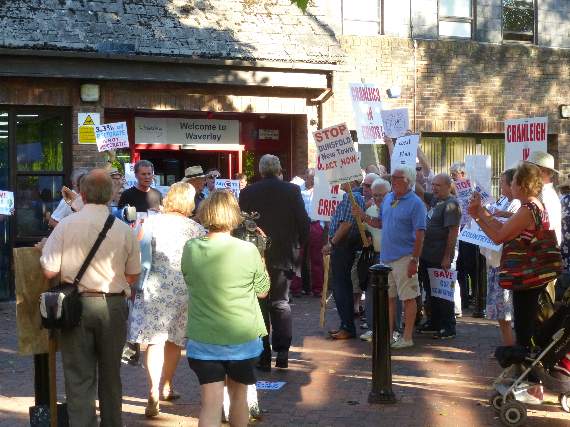
A MASS demonstration was staged outside Waverley offices last Tuesday night before the council approved publication of the borough’s draft Local Plan to build up to 10,000 houses in the next 16 years.
Councillors ran the gauntlet of more than 70 chanting, banner-wielding objectors, many of whom packed into the public gallery afterwards to make their presence felt during the meeting.
But any hopes of a rethink on proposals to build 2,600 houses at Dunsfold Aerodrome, 2,330 in Farnham, 1,520 in Cranleigh, 1,2450 in Godalming, 830 in Haslemere and around 1,000 in the villages, were dashed when Waverley’s decision-making council agreed - with three abstentions - to agree the draft document can go out to public consultation.
Acknowledging the strength of local opposition to building double the number of houses proposed in Waverley’s failed 2013 draft Local Plan in order to meet increased Government housing targets, committee members urged residents to make their views known when the six-week consultation opens in early August.


There were shouts of “hear hear” from the public gallery, when Protect Our Waverley deputy chairman Chris Britton used the informal public questions slot to protest that “45 per cent of all new development was planned in the most unsustainable and least accessible part of the borough” and ask when Waverley will “start to consult properly with us”.
Waverley Leader Julia Potts responded to say the public consultation was a further opportunity for residents to raise concerns. Later, when concluding the debate on whether to approve the recommendation to publish the draft document, she told residents: “Give us your thoughts. This is more opportunity to help us shape the borough for the future.”
Many committee members voiced concerns about whether the local infrastructure could cope with building at least 519 new houses a year until 2032, but said they would be voting in support of the document to try and ensure Waverley has its Local Plan in place before the government deadline of early 2017. After that, the Planning Inspectorate will take control of any Local Plans not yet submitted.
“We would have liked to limit the number of houses on sustainability grounds,” Waverley’s planning portfolio holder Brian Adams said. “But it’s all been investigated and reviewed and no one has come back to say the plan is undeliverable.”
Farnham councillor Pat Frost told the meeting: “This has caused a lot of angst. It’s unfortunate the way the borough is arranged, so that most of the housing will go to Farnham and Cranleigh. But the fact is we need houses and we need to make sure we are in charge of what’s put in, otherwise we will have no say.
“I am as concerned about Cranleigh as I am about Farnham but we don’t want to be told by the Planning Inspectorate what they will do to us.”
Haslemere councillor Stephen Mulliner said: “It’s no surprise there was a demonstration outside. Those with serious objections should also make their voices heard at the Local Plan examination. I encourage those with concerns to use that opportunity.”
Opposition member Farnham Independent Andy Macleod voted in support but said he was concerned that in addition to the 2,330 houses allocated for the town, neighbouring county authorities were proposing 20,000 houses close by.
“That means 30,000 more cars and a much bigger problem,” he said. “I’m not convinced that’s been taken into account. A great deal of work still needs to be done.”
Former Waverley Leader Haslemere councillor Robert Knowles abstained from the recorded vote, together with Godalming councillor Stefan Reynolds and Bramley councillor Richard Seaborne.
Mr Knowles was clapped by the public gallery when he condemned Surrey County Council’s traffic impact assessment report: “It’s very poor indeed,” he said. “It’s full of woolly promises and assumptions. The traffic is going to be terrible and to pretend it isn’t makes us look very stupid. It’s a serious problem and it’s being swept under the carpet.”
Concluding, Miss Potts said: “It is crucial to understand this is just part of the planning process and any development identified will go through the usual tests for any planning application.”
Comments
This article has no comments yet. Be the first to leave a comment.