
HAMPSHIRE and Thames Valley police have delivered a stark warning: “There’s no such thing as safe speeding.”
And the forces have embellished the message by adding: “The speed limit is a limit, not a target. You have to drive within it to stay in proper control.”
Throughout this week (April 16-22), the police have been joining other forces across the UK and in Europe to tackle this issue and highlight to motorists that travelling at illegal or inappropriate speeds is the single biggest factor in fatal road collisions.
On average, excessive or inappropriate speed was a contributory factor in 20 per cent of road deaths and 12 per cent of all serious casualties across Hampshire and the Thames Valley region.



The higher a driver’s speed, the more likely the injuries to themselves or other road users will be severe or fatal in a collision.
Sergeant Rob Heard, from the roads policing unit for Hampshire and the Thames Valley, said: “People need to realise it’s a speed limit and not a target, so it may be more appropriate to travel at a lower speed depending on the road conditions for their own safety.
“Drivers can become complacent about roads they are familiar with, causing them to be less alert to the road, and drive at a faster speed.
“A few miles an hour over the speed limit or travelling at inappropriate speed can have catastrophic upon road users and their families, many of whom also suffer lasting and profound consequences from collisions where a loved one has been killed or seriously injured.
“Excessive speed will reduce the time you have to react to a hazard and further the distance it takes for you to stop.”
Sgt Heard outlined key factors:
* Speed is one of the main factors in fatal road collisions;
* The risk of death is approximately four times higher when a pedestrian is hit at 40mph than at 30mph;
* Fatal accidents are four times as likely on rural ‘A’ roads than urban ‘A’ roads;
* If drivers slowed down on average by only one mile per hour, about 1,300 road deaths per year could be prevented, among them 800 on rural roads, 400 on urban roads, and around 80 on motorways;
* Sixty per cent of fatalities occur on rural roads and more fatalities per mile than on urban roads or motorways.
* Top contributory factor to KSIs on rural roads is loss of control, which is often associated with speed;
* Young male drivers aged 21 to 29 are most at risk of speeding.
Sgt Rob Heard said: “The average reaction time from seeing an emergency situation to actually placing your foot on the brake pedal is around one to one-and-a-half seconds in an urban area. At 30mph, then minimum total stopping distance would be 26 metres on a dry average road surface. If you travel at 35mph then the total stopping distance increases to 33-and-a-half metres.”
He added: “We are committed to increasing road safety and will continue to target those who fail to abide by the speed limits. Some people think it is ok to travel just a little over the speed limit. However, a few miles per hour can make a significant difference to you reacting and being able to avoid a hazard or collision.
“If you hit a pedestrian at 40mph then they only have a survival chance of 10 per cent, whereas if you hit a pedestrian at 30mph then they have an 80 per cent chance of survival, so please drive appropriately, it’s not worth the risk.”
Sgt Heard continued: “Our aim is simply to improve the knowledge, attitudes and behaviour of any drivers who speed, thereby reducing the likelihood of the driver being involved in a future speeding incident and make our roads safer.”
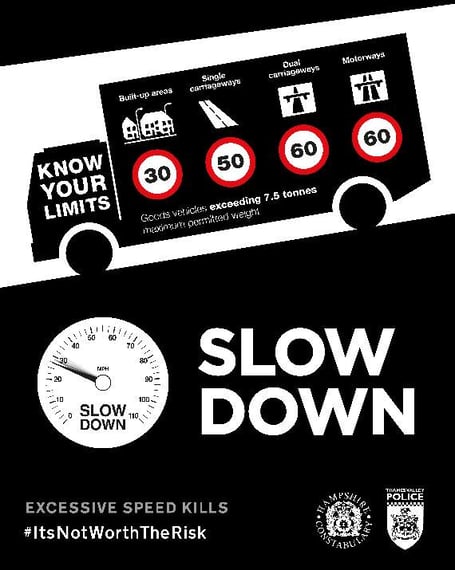
Police are also reminding the drivers of certain vehicles that on certain roads they are restricted to lower speeds.
“The majority of commercial vehicle drivers do drive considerately and legitimately on our highways. However, our officers are catching far too many van drivers who are not aware of speed restrictions associated with their vehicles - it’s no excuse.
“To help drivers we have created the two images for goods vehicles of different sizes to help them remember their limits.”
Comments
This article has no comments yet. Be the first to leave a comment.