
THE EU Referendum debate came to Farnham last week, as the Maltings hosted a lively - and at times fiery - discussion of the various merits of leaving and remaining in the European Union.
Around 400 people flocked to the Maltingsto hear four panellists representing both the Leave and Remain campaigns put forward their cases and respond to public questions.
No show of hands was taken on the audience’s preference to vote in or out - although the volume and frequency of heckles suggested a marginal lean towards the Remain camp.
However, a show of hands was taken on whether anybody had changed their minds as a result of the debate - with only two of the 400 people present tentatively raising their hands, hinting at how entrenched the discussion has become.

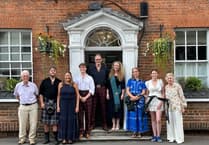
The debate continued the Maltings’ recent forays into politics, following a similar hustings event before the 2015 General Election, and was chaired by Tony Pryor, chairman of the Hampshire branch of the European Movement.
Aldershot’s long-standing Tory MP Sir Gerald Howarth represented the Leave camp alongside operations manager for the Campaign for an Independent Britain John Petley.
And putting forward the case for Britain to remain in the EU were Lib Dem spokesman for environment and rural affairs Baroness Kate Parminter alongside former Labour MEP and Surrey county councillor Robert Evans.
Each speaker was given six minutes to put forward their case (as reported in more detail on page three of this week’s Herald) before a public Q&A session.
The debate at times followed the same course as the national discussion, with both sides accusing each other - and the prime minister - of “scaremongering”.
However, unlike the national discussion, the Maltings debate was on the whole well-natured and each panelist provided unique insight on their experiences of working with, and against, the European Union.
Topics ranged from the EU’s stifling “red tape” for UK businesses to Britain’s ability to restrict the free movement of people and the role of the European Union in “binding nations together” and ensuring the security of its member states.
The first question from the floor concentrated on ‘red tape’ and in response Sir Gerald asserted that just one in 20 UK businesses export to the EU and yet all firms have to “obey EU directives”, adding that Britain is more than capable of adopting its own legislation to protect workers’ rights.
Fellow Leave campaigner Mr Petley added the EU is merely a “conduit to red tape” and the UK would still be bound to global standards of workers’ rights if outside of the EU.
Baroness Parminter rejected the term ‘red tape’ altogether however, and said the EU’s various initiatives are the means to creating a level playing field and ensuring environmental and work-time standards are met. Mr Evans also expressed doubt on the UK Government’s ability or willingness to protect the conditions of workers, and pointed to the recent example of Sports Direct.
Turning to Britain’s EU membership fee, both Sir Gerald and Mr Petley conceded the Leave campaign’s controversial claim that the UK ‘sends the EU £350 million a week’ is “unhelpful” but added the UK should be able to spend the £19.6 billion it sends to the EU every year on its own priorities, not those decided in Brussels.
Countering this argument, Mr Evans said the UK economy receives a net gain from its EU membership and added he is “very proud” of the money the UK invests in developing poorer countries in and out of Europe.
Baroness Parminter added the money Britain sends to the EU “benefits all of us” by helping tackle climate change and investing in British industry. “Britain is now the biggest beneficiary of the EU’s science and research budget,” she continued.
In terms of immigration, Mr Evans said migrant workers are “essential” to the UK economy while Baroness Parminter said migrants pay far more in tax than they take out in in-work benefits and are an “easy scapegoat for problems we should solve ourselves”.
Sir Gerald said it is a “national disgrace” that the UK has to import cheap labour when two million British people are currently unemployed, and blamed migrants for Britain’s housing shortage. “The South East is very overcrowded and we cannot sustain this level of migration.” he added.
Mr Evans dismissed fears that Turkey may soon join the EU allowing the free movement of its residents to the UK as “fanciful”, commenting that this would require the unlikely agreement of every EU member state - Britain included. He also stressed that the EU is vital to the security of Britain and Europe as a whole, providing “a democratic structure that binds us all together”.
Sir Gerald said the EU is not set up to provide collective security, however, and accused the European Union of undermining NATO by seeking to expand its own defence capabilities in the immediate aftermath of the June 23 referendum - a claim fiercely disputed by both Remain campaigners.
Mr Petley presented the recent case of Germany and Greece as evidence that the EU is driving nations apart rather than together and, later asked what he admires about his opponents’ campaign, replied “I would no sooner vote to Remain than I would strangle my wife”.
Responding to the same question, Mr Evans said he admires the Leave campaign’s ideas for the future of Britain but added “it is a shame it is all complete fiction”.
The meeting closed on an unsavoury note with accusations that women and young people had been under-represented after each question bar one was tabled by middle-aged men, and perhaps reflective of the national mood many left the Maltings grumbling.
Polling stations will open between 7am and 10pm next Thursday, June 23. All registered voters should have now received a polling card telling them where they can cast their vote. Counting will take place overnight into Friday morning with a projection of the result expected at around 4am.
Comments
This article has no comments yet. Be the first to leave a comment.