
.jpeg?width=455)
On Thursday, May 7, 2026, voters across Surrey will not just be picking councillors; they will be helping to build an entirely new way their local area is run. This is not ‘council business as usual’; it is a once-in-50-years reset.
Instead of voting for county or borough councillors like before, residents will elect politicians to two brand new councils, East Surrey and West Surrey, which will soon take over everything from bins to schools.
This will be a local election like no other. It is a rare moment where voters get to shape not just who runs the council, but how the entire system works for years to come.
If you have ever complained about bins, potholes or planning decisions, this is probably one of the most important chances you will get to influence how all of that is handled in the future.


A total shake-up of local government
Surrey’s council system is being scrapped and rebuilt. From April 2027, Surrey County Council and all 11 borough and district councils will disappear. In their place will be just two ‘unitary authorities’: East Surrey Council and West Surrey Council.
These new councils will handle all local services, things that are currently split between different layers of government, like:
- education
- road maintenance
- bin collections
- housing
- social care
The idea, according to ministers, is to make things simpler and quicker, especially when it comes to decisions like planning.
So who votes for what?
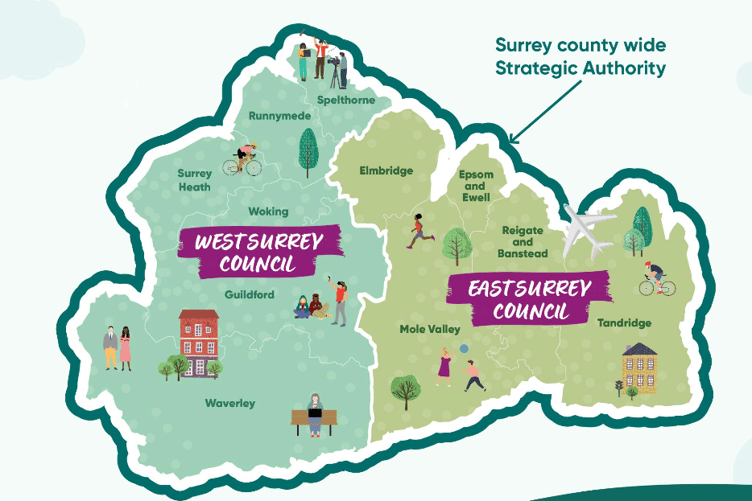
Where you live decides which new council you vote for. Each area will elect councillors to its respective new authority.
East Surrey covers:
- Elmbridge
- Epsom & Ewell
- Mole Valley
- Reigate & Banstead
- Tandridge
West Surrey covers:
- Guildford
- Runnymede
- Spelthorne
- Surrey Heath
- Waverley
- Woking
Why these elections actually matter more than usual
This is the key difference: the people elected in May will not just be running things, they will be building the system itself. Councillors will serve until 2031, but first they will act as a ‘shadow authority’ for nearly a year.
That means they will:
- decide budgets and council tax for 2027/28
- design how the new councils are structured
- sort staffing and leadership
- set the rules (codes of conduct, allowances, governance)
- oversee the handover from the old councils
Then, from April 2027, they will take full control of services.
Essentially, voters are not just choosing representatives. They are choosing the architects of Surrey’s future local government.
Bigger councils, new voting system (sort of)
There are also some practical differences on the ballot paper.
East Surrey Council: 72 councillors across 36 wards
West Surrey Council: 90 councillors across 45 wards
Each ward elects two councillors, and you can vote for up to two candidates. The top two win, a straightforward ‘first past the post’ system.
No usual council elections this year
Another big change: you will not be voting for your usual councils in 2026. County, borough and district councillors will stay in post until March 2027. So no county council elections and no borough/district elections (unless there is a by-election). For now, services will carry on as normal until the big switch happens next year.
A bit of political context
These elections follow a controversial decision to cancel last year’s county council vote. Some critics argued that it took away people’s say. Now, this election is effectively replacing that but with much higher stakes, because it shapes an entirely new system.
Expect all the usual parties – Conservatives, Liberal Democrats, Labour, Greens plus independents and Reform – to compete hard, especially given the scale of change.
What will people actually vote on?
While the structure is new, the issues are familiar. Expect debates around:
- potholes and road repairs
- housing developments
- SEND (special educational needs) support
- council finances and debt
The difference is: whichever council wins will control all of these areas, not just part of them.
How to make sure you can vote
If you want a say, there are a few key deadlines:
Register to vote by: midnight, April 20, 2026
Postal vote deadline: 5pm, April 21
Proxy vote deadline: 5pm, April 28
You can vote:
- in person
- by post
- by proxy (someone votes on your behalf)
And don’t forget: you’ll need photo ID at the polling station (passport, driving licence, bus pass, etc.).
No ID? You can apply for a free Voter Authority Certificate by April 28.
Find out more about the elections here.
Comments
This article has no comments yet. Be the first to leave a comment.