
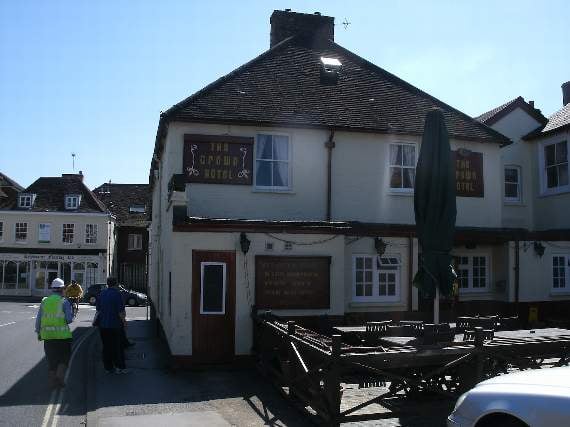
THE ‘reckless disregard’ for safety shown by the owner of an Alton pub left two men trapped and fighting for their lives in a collapsed tunnel.
The company Coronita Ltd, which owns the Crown Hotel, and its director Steve Austen, exposed employees and the public to unnecessary risk in ordering excavations underneath the High Street pub and ignoring warnings about the safety of the work.
In a case brought by East Hampshire District Council’s (EHDC) health and safety officers, a district judge at Basingstoke Magistrates’ Court heard that bar staff Ben Collins, then 26, and Matthew Bishop, then 23, were informally employed to deepen an existing cellar and excavate a connecting tunnel to a cellar bar under the 16th century building.
During the work on April 19, 2015, part of the unsecured earthen walls collapsed and trapped both men underground. Mr Bishop was buried up to his chest in rubble and was asphyxiating due to the weight of the soil bearing down on him.




Mr Collins managed to free himself and began tearing away at the earth with his fingers in an attempt to free Mr Bishop. He eventually had to resort to using a power breaker to shift large lumps of solid earth lying across his friend’s chest that were preventing him from breathing.
As he continued to dig out Mr Bishop, he discovered a bone protruding from his right ankle. He attempted to keep the site of the injury clean to avoid infection.
The event has left both men suffering from post-traumatic stress disorder, while Mr Bishop’s injuries were such that he required emergency surgery for a fractured right scapula, a fractured right wrist, the open fracture to the right ankle, and knee ligament damage.
He was confined to a wheelchair for some time after the accident. The overall psychological impact of the incident has had a severe effect on his personal life, his employment, and the lives of his family.
The court heard that the work had been inspected by a structural engineer on March 26, a few weeks before the incident.
The structural engineer told Mr Austen that the excavation had undermined the foundations of the building and that no further work should be undertaken until the basement was securely underpinned.
Furthermore, earlier in the project a third employee had reported he had been trapped up to his knees by falling rubble. The incident was reported to Mr Austen and resulted in the response “be careful”.
In passing sentence, on May 4, District Judge Philip Gillibrand also considered a similar excavation carried out in 2012 where the company engaged the advice of EHDC’s building control team to oversee the work and employed a structural engineer to prepare an appropriate method statement and risk assessment to ensure the work went through safely.
District Judge Gillibrand said: “With all the previous knowledge and experience of this earlier work, how did the defendants in the current case behave? Firstly, they failed to carry out any risk assessment, obtain a method statement or obtain building control supervision. Secondly, they failed to obtain building consent for the excavation work despite an express notice in the grant of planning consent. Thirdly, they employed their own bar staff, with no or minimal building experience, to carry out the work in their spare time, cash in hand!”
The day after the collapse an inspection of the excavation by EHDC health and safety inspector Mark Jewell found that the walls were without any form of support or underpinning, apart from one small section, which was incomplete. Further, the whole of the back of the building was liable to collapse onto the adjacent public street.
“The recommendations of the structural engineer had clearly been disregarded,” said District Judge Gillibrand.
He said the company had shown a “reckless disregard” of the need for risk assessments and building control supervision.
Both defendants pleaded guilty to two offences each – exposing employees to risks, under the Health and Safety at Work Act 1974, and of failing to make a suitable assessment of the risks under the Management of Health and Safety at Work Regulations 1999.
He fined Coronita Ltd £20,000 after taking into account its annual turnover, a timely guilty plea and other factors.
Of Mr Austen, he said: “At the time of the incident he was 60 years of age and, frankly, should have known better. Even if he lacked the actual foresight, he was certainly wilfully blind to the risks that he exposed others to even before the visit of the structural engineer on March 26 – thereafter those risks he was nevertheless prepared to take.
“That meeting equipped Mr Austen with the knowledge of the real risk of significant danger he was exposing Mr Collins and Mr Bishop to. However, despite that, and armed with his age and experience of life, he did nothing to protect those individuals he was duty bound so to do.”
Austen was sentenced to 26 weeks’ imprisonment, suspended for 24 months.
Mr Jewell said: “Risk assessment is the cornerstone of any safety-management system to ensure that work activities are safe. This situation would have been entirely preventable from the outset had Coronita Ltd and Mr Austen conducted a risk assessment to ensure the right controls were in place and maintained.
“However, despite warnings and opportunities to address the situation work continued, placing the employees and those using the premises at risk of serious personal harm. It was more by luck than judgment that Mr Collins was able to dig Mr Bishop out of the collapsed material and save his life, a commendable action indeed.”
The legal and investigation costs amounted to £17,486.04. Coronita Ltd has been ordered to pay £11,657.36 and Austen the remaining £5,828.68.
Comments
This article has no comments yet. Be the first to leave a comment.