
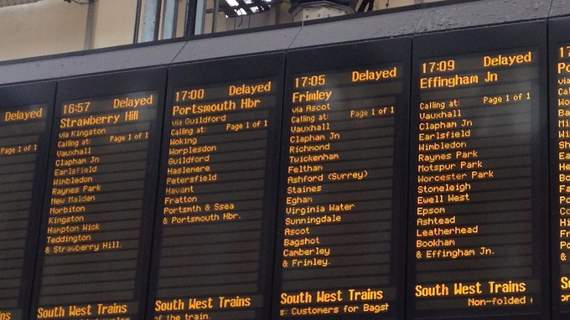
RAIL passengers already hit by three 24-hour strikes in the past fortnight, face more walkouts throughout August.
South Western Railway (SWR) and the RMT union agreed to hold talks last week, after the third 24-hour strike last Tuesday, over the role of guards.
But the RMT said it had not suspended any of its planned walkouts after agreeing to meet at the conciliation service ACAS.
Previous walkouts took place at the end of July, and further 24-hour strikes are scheduled for August 11 and 18, culminating in a 48-hour walkout from August 31 to September 1.


Responding to the latest setback for passengers, the Haslemere Rail Users Group (HRUG) watchdog said SWR’s operational difficulties mean the future of its services and the new timetable will need to be renegotiated with the Department of Transport as many industry experts warned last week the franchise could fail.
Since SWR took over the franchise a year ago, a 7.9 per cent fall in passenger demand has been recorded – equivalent to around 18 million fewer customers.
SWR said it was “working hard” to minimise the impact of the strikes and reported nearly 70 per cent of normal services were run, with the Waterloo experiencing “just a 12 per cent drop” in customer numbers.
An SWR spokesman said: “It is frustrating and disappointing the RMT union has decided to go ahead with plans to strike on our network. This is despite proposals we have put forward which are similar to that of another train operator, Greater Anglia, which the RMT has recently agreed to. We are urging the RMT to return to talks and end this damaging disruption to passengers.
“We are sorry this industrial action is inconveniencing many of our passengers, and will continue to do everything we can to keep passengers moving.”
HRUG secretary Martin Odell reported SWR had managed to keep the disruption caused by the strikes to a minimum for Haslemere rail passengers, but customer satisfaction with the service was at an all time low locally.
Mr Odell said: “While the strike impact has been minimal, the problems of signal failures, overheated rails, cancellations, delays and other and operational difficulties have not.
“When there is an unexpected disruption to the line, SWR seem incapable of responding, and useless at providing any information as to what is going on, which leads to mass confusion and frustration, and episodes of ’total chaos’ at Woking on the way home.”
SWR has come under increasing scrutiny over the performance of its rail services since taking over the franchise last August.
In April, Transport Secretary Chris Grayling announced an independent review had been commissioned by the Government into its performance. The review, which is being led by Sir Michael Holden, is expected to be concluded shortly.
In the meantime, a July report by The Office of Rail and Road (ORR) blamed Network Rail for 68 per cent of the delays on services and has called on them to improve planning and procedures.
In a letter to fellow MPs, back in April, Mr Grayling said: “I have been very disappointed with the performance of SWR in recent months. I am determined that we see a long-term, sustained performance across this route.”
Last December, SWR was one of three train operators singled out for its poor or declining performance, with recognition that 72 per cent of its delays were attributable to Network Rail.
It was also revealed in the train company’s customer report summary, covering the seven-month period since they took over the franchise from South West Trains in August 2017, that almost half (45.3 per cent) of all their services failed to turn up on time.
The report also showed just 83.2 per cent of trains arrived at the terminating station within five minutes of their advertised time for commuter services and within 10 minutes for long distance services.
Responding to the criticism, both SWR and Network Rail admitted: “Performance on this route hasn’t been good enough.”
Comments
This article has no comments yet. Be the first to leave a comment.